广告
加载中

顺丰成为首批入驻千问快递企业 “AI对话式服务”生态布局持续扩容

龚作仁 2026-08-11 12:49
龚作仁 2026/08/11 12:49

邦小白快读

EN
全文速览

本文核心内容是顺丰作为首批物流行业服务商接入千问开放平台,推出AI对话式寄查快递服务,用户无需跳转顺丰APP即可在千问内完成全流程操作,核心重点和实操干货如下:

1.寄件操作流程:用户有寄件需求或者咨询运费时效时,直接在千问的顺丰速运智能体对话框输入自然语言需求即可,比如“寄一份文件到上海”,智能体会以功能卡片引导填写地址、核验可寄物品、预估运费和送达时间,从咨询、下单、修改到取消订单,全程都能在千问内完成,不需要跳转外部应用。

2.查件操作流程:查件的时候只需要提供运单号、收寄城市、收寄人姓名等任意一项相关信息,就能精准定位包裹,智能体会以卡片展示完整物流轨迹和预计送达时间,一句话就能完成查询,操作十分简便。

这种新服务降低了老年人、视障群体的使用门槛,能给用户带来更便捷的物流服务体验。

本文给物流及相关行业品牌商带来的干货,围绕品牌布局、产品升级和消费趋势等方面展开,核心内容总结如下:

1.品牌渠道拓展:顺丰依托自有AI能力,以智能体形式接入主流大模型开放生态,打破了原有服务仅局限于自有APP的限制,将服务触达延伸到更广阔的公域场景,能获取更多潜在用户,为品牌渠道建设提供了新方向。

2.产品升级方向:当前消费端越来越青睐便捷化、低门槛的服务,原生AI对话式服务符合用户新的使用习惯,还能覆盖老年人、视障群体等之前使用门槛较高的用户群体,有效提升品牌口碑和覆盖范围。

3.生态合作模式:顺丰选择开放对接主流AI生态的路径,推动自身服务从工具型向原生AI服务进化,契合当前AI大模型渗透各行各业的趋势,能帮助品牌更快融入多元数字生活场景。

本文给各类卖家带来的干货围绕新机会、发展方向和经验参考展开,核心内容如下:

1.新增量机会:随着千问等大模型开放平台上线,AI平台已经成为新的服务流量入口,卖家不管是做服务还是做实物零售,都可以考虑对接这类AI开放平台,把自身的咨询、下单等服务植入大模型生态,开辟新的获客路径,挖掘新增量。

2.服务升级参考:对话式原生AI服务能大幅降低用户的操作门槛,全流程闭环无需跳转的模式,可以减少用户在操作流程中的流失,有效提升转化和用户体验,这对卖家优化服务流程有很强的参考意义。

3.趋势提示:当前AI大模型正在重构服务行业的交互逻辑,提前布局开放生态合作、打造AI原生服务,能帮助卖家提前抓住趋势红利,建立差异化竞争优势,卖家可以结合自身业务尝试布局新的服务模式。

本文对生产制造工厂的干货围绕数字化转型、商业拓展的启示展开,核心内容总结如下:

1.数字化转型启示:当前AI大模型已经加速渗透到包括服务业在内的各行各业,交互方式正在发生根本性改变,工厂在推进自身数字化服务升级时,可以参考这种自然对话式的交互模式,优化面向C端用户的咨询、下单等服务流程,降低用户操作门槛,提升服务体验。

2.商业拓展机会:开放AI生态给各类企业提供了新的触达用户的渠道,对于开展直接To C业务的工厂来说,可以考虑将自身的产品咨询、下单等服务以智能体形式接入主流大模型开放平台,无需完全依赖自有平台或者独立APP,就能触达更多潜在用户,拓展销售渠道。

3.方向提示:未来服务会朝着无处不在的环境智能方向发展,工厂推进数字化和电商布局时,可以朝着AI原生服务的方向探索,提前布局跟上行业趋势,提升自身的市场竞争力。

本文对AI技术服务商、物流技术服务商等相关服务商的干货围绕行业趋势、客户痛点和解决方案展开,核心内容如下:

1.行业发展趋势:当前AI大模型正在加速重构物流这类高频刚需民生服务的交互方式和底层逻辑,对话式原生AI服务已经从概念走向落地,成为行业明确的发展方向,市场需求和发展空间都十分广阔。

2.客户核心痛点:传统物流服务长期局限在独立应用中,用户需要下载跳转才能使用,操作门槛较高,对老年人、视障群体不够友好,同时品牌方的服务触达也受限于自有平台,流量增长遇到瓶颈,这是服务商可以抓住的客户需求。

3.解决方案参考:顺丰对接千问开放生态的模式验证了开放合作路径的可行性,帮助企业以较低成本快速实现场景拓展,完成AI服务升级,服务商可以围绕这类开放生态合作,为客户打造智能体接入、全流程闭环服务的相关解决方案,匹配客户需求。

本文对AI开放平台、电商服务平台等平台类商家的干货围绕生态建设、运营管理的方向展开,核心内容如下:

1.平台生态需求:大模型开放平台引入各行各业的头部服务商入驻,能丰富平台的服务品类,满足用户在平台内的一站式刚需服务需求,有效提升平台的用户粘性和使用频率,顺丰作为头部物流企业首批接入,验证了大模型平台对实体服务企业的吸引力,开放生态对双方都有价值。

2.平台运营方向:引入垂直领域的头部服务商,打造闭环的原生AI服务,能形成平台的差异化竞争力,物流属于高频刚需服务,接入平台后能大幅提升用户的日常打开频率,带动平台整体活跃,这对平台招商和生态建设有参考意义。

3.运营注意事项:平台在引入服务智能体时,需要支持服务商在平台内完成全流程服务闭环,不需要用户跳转外部应用,才能保证良好的用户体验,这是平台运营过程中需要注意的点,同时也要优先引入刚需领域的头部服务,更快完善生态。

本文给产业经济、AI落地应用领域的研究者提供了大模型渗透传统服务业的最新一手案例,核心干货总结如下:

1.产业新动向:当前传统物流服务正在发生根本性变化,已经从原来依托独立APP的工具型服务,逐步进化为无处不在的原生AI对话式服务,AI大模型已经实实在在重构了传统服务业的交互方式和底层商业逻辑,这是产业升级的最新动向。

2.创新商业模式:传统企业落地AI的新路径已经出现,就是开放生态合作模式,传统企业输出自身的核心服务能力,以智能体形式接入第三方大模型开放生态,既能快速拓展服务场景,又能降低AI落地的研发和推广成本,实现大模型平台和服务企业的双赢,是值得深入研究的新商业模式。

3.新研究方向:本文案例显示,环境智能将是未来服务业的核心发展方向,服务将不再受限于独立应用,会全方位融入各类数字生活场景,这为产业研究、AI落地研究提供了新的课题方向,具备较高的研究价值。

返回默认
声明:快读内容全程由AI生成,请注意甄别信息。如您发现问题,请发送邮件至 run@ebrun.com 。

我是 品牌商 卖家 工厂 服务商 平台商 研究者 帮我再读一遍。

Quick Summary

This article covers that SF Express, as one of the first logistics service providers to access Alibaba's Qwen Open Platform, has launched an AI-powered conversational shipping and package tracking service. Users can complete the entire service process directly within Qwen without switching to the SF Express app. Key details and practical takeaways are as follows:

1. Shipping process: When users need to ship a package or inquire about shipping costs and delivery times, they can simply enter their natural language requests in the SF Express agent chat window on Qwen. For example, by sending "Ship a document to Shanghai", the agent will guide users through address filling, prohibited item verification, shipping cost estimation and delivery time confirmation via functional cards. The entire process from inquiry, booking, order modification to cancellation can be completed within Qwen, with no need to redirect to external apps.

2. Package tracking process: For tracking, users only need to provide any one piece of related information — such as the tracking number, origin and destination cities, or sender/receiver name — to accurately locate their package. The agent will display the full logistics trajectory and estimated delivery time via a card, enabling one-sentence query completion for extremely simple operation.

This new service lowers the usage barrier for elderly and visually impaired users, delivering a more convenient logistics experience for all customers.

This article summarizes key insights for brand owners in the logistics and related industries across brand expansion, product upgrading and consumer trends, as follows:

1. New channel expansion opportunities: Leveraging its in-house AI capabilities, SF Express accessed a mainstream large model open ecosystem in the form of an AI agent, breaking the original restriction that its services were only available within its own app. This extends service reach to broader public domain scenarios to acquire more potential users, opening up a new direction for brand channel development.

2. Clear product upgrading direction: Consumers today increasingly prefer convenient, low-threshold services. Native AI conversational services align with new user habits, while also expanding access to previously underserved groups including elderly and visually impaired users, effectively boosting brand reputation and market reach.

3. Future-proof ecosystem cooperation model: SF Express's choice to open up and connect with mainstream AI ecosystems pushes its services to evolve from tool-based to native AI-powered services, aligning with the current trend of large-scale AI models penetrating all industries. This approach enables brands to integrate faster into diverse digital life scenarios.

This article summarizes key takeaways for all types of sellers on new opportunities, development directions and practical references, as follows:

1. Unlock new growth opportunities: With the launch of large model open platforms such as Qwen, AI platforms have emerged as new service traffic entry points. Whether you operate a service or physical retail business, you can consider connecting to such AI open platforms and embedding your consulting, ordering and other services into the large model ecosystem to open up new customer acquisition paths and tap new growth.

2. Practical reference for service upgrading: Native conversational AI services drastically lower user operation barriers, and the fully closed-loop in-platform process without redirection reduces user drop-off during operation, effectively improving conversion and user experience. This offers strong reference value for sellers looking to optimize their service processes.

3. Early trend提示: Large AI models are currently restructuring the interaction logic of the service industry.布局ing open ecosystem cooperation and building native AI services early helps sellers capture trend dividends and build differentiated competitive advantages. Sellers can test and layout new service models based on their own business characteristics.

This article summarizes insights for manufacturing factories on digital transformation and business expansion, as follows:

1. Inspiration for digital transformation: Large AI models are accelerating penetration into all industries including services, and interaction methods are undergoing fundamental change. When factories推进 their own digital service upgrades, they can reference this natural conversational interaction model to optimize C-side-facing processes such as consultation and ordering, lower user operation barriers and improve service experience.

2. New business expansion opportunities: Open AI ecosystems provide all types of enterprises with new channels to reach users. For factories that operate direct-to-consumer businesses, they can embed their product consultation, ordering and other services as an agent into mainstream large model open platforms, reaching more potential users and expanding sales channels without fully relying on their own platforms or independent apps.

3. Direction提示: Future services will develop toward ambient intelligence that is available anywhere. When factories推进 their digital transformation and e-commerce布局s, they can explore the direction of native AI services,布局 early to keep up with industry trends and improve their market competitiveness.

This article summarizes key insights for AI technology service providers, logistics technology service providers and other related service providers across industry trends, customer pain points and solution references, as follows:

1. Clear industry development trend: Large AI models are accelerating the restructuring of interaction methods and underlying logic for high-frequency, essential civilian services such as logistics. Native conversational AI services have moved from concept to real-world implementation, becoming a clear industry development direction with broad market demand and growth space.

2. Unmet core customer pain points: Traditional logistics services have long been confined to independent apps, requiring users to download and switch between apps to access services, creating high operation barriers that are unfriendly to elderly and visually impaired users. Meanwhile, brand service reach is limited by their own platforms, creating bottlenecks for traffic growth. These pain points represent high-value customer needs service providers can capture.

3. Feasible solution reference: SF Express's integration with the Qwen open ecosystem validates the feasibility of the open cooperation path, helping enterprises quickly expand service scenarios and complete AI service upgrades at low cost. Service providers can develop related solutions around this open ecosystem cooperation model, covering agent access and full closed-loop service delivery to match customer demand.

This article summarizes key insights for platform businesses such as AI open platforms and e-commerce service platforms across ecosystem building and operation management, as follows:

1. Mutual value of open platform ecosystems: When large model open platforms onboard leading service providers from various industries, they enrich platform service categories to meet users' demand for one-stop essential services directly within the platform, effectively improving user stickiness and usage frequency. As a leading logistics enterprise that joined as one of the first partners, SF Express validates the attractiveness of large model platforms to physical service companies, proving open ecosystems create value for both sides.

2. Clear platform operation direction: Onboarding leading vertical service providers to build closed-loop native AI services helps platforms build differentiated competitive advantages. As a high-frequency essential service, logistics integration significantly increases users' daily platform open frequency and drives overall platform activity. This offers valuable reference for platform merchant recruitment and ecosystem building.

3. Key operation considerations: To ensure a positive user experience when onboarding service agents, platforms need to enable providers to deliver a full closed-loop service directly within the platform, eliminating the need for users to redirect to external applications. Platforms should also prioritize onboarding leading services in high-demand essential fields to完善 ecosystems faster.

This article provides researchers in industrial economics and AI implementation with a first-hand latest case of large model penetration into traditional service industries, with key takeaways as follows:

1. New industrial trends: Traditional logistics services are currently undergoing fundamental change, evolving from tool-based services relying on independent apps to ubiquitous native AI conversational services. Large AI models have tangibly restructured the interaction methods and underlying business logic of traditional services, representing the latest trend of industrial upgrading.

2. Innovative business model: A new path for traditional enterprises to implement AI has emerged: the open ecosystem cooperation model. Traditional enterprises output their core service capabilities as an agent to access third-party large model open ecosystems, enabling rapid service scenario expansion while reducing R&D and promotion costs for AI implementation. This creates a win-win outcome for both large model platforms and service enterprises, making it a new business model worthy of in-depth research.

3. New research directions: This case shows ambient intelligence will be the core development direction of the future service industry, where services will no longer be confined to independent applications and will integrate comprehensively into all kinds of digital life scenarios. This opens up new research topics for industrial research and AI implementation research, with high research value.

Disclaimer: The "Quick Summary" content is entirely generated by AI. Please exercise discretion when interpreting the information. For issues or corrections, please email run@ebrun.com .

I am a Brand Seller Factory Service Provider Marketplace Seller Researcher Read it again.

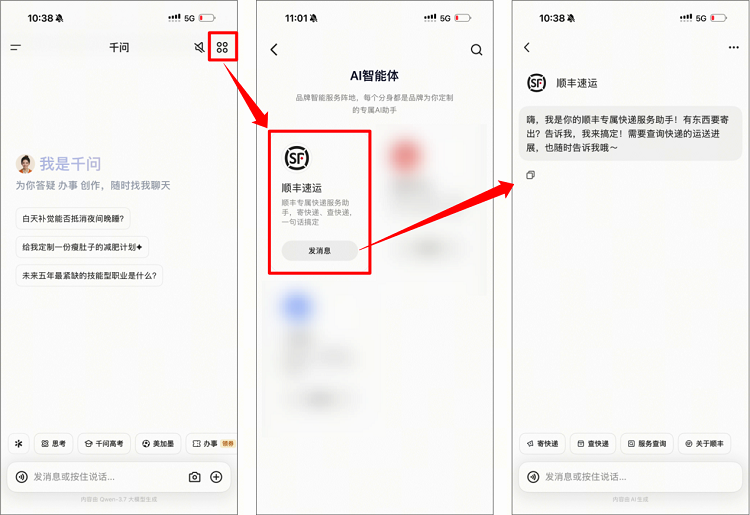
8月10日,千问开放平台上线,顺丰作为首批物流行业服务商率先完成对接,在“AI对话式快递服务”领域再添新渠道。顺丰基于自有智能体“AI小丰”能力,将寄查件服务以智能体的形式接入千问生态。用户在千问内的“顺丰速运”智能体中通过自然对话即可完成寄件与查件,体验更便捷的AI物流服务。从顺丰小程序内自研的“AI小丰”到千问等主流AI平台,顺丰正加速输出智慧物流服务能力,推动“AI对话式快递服务”向更多场景铺开。

像聊天一样寄快递、问运费时效

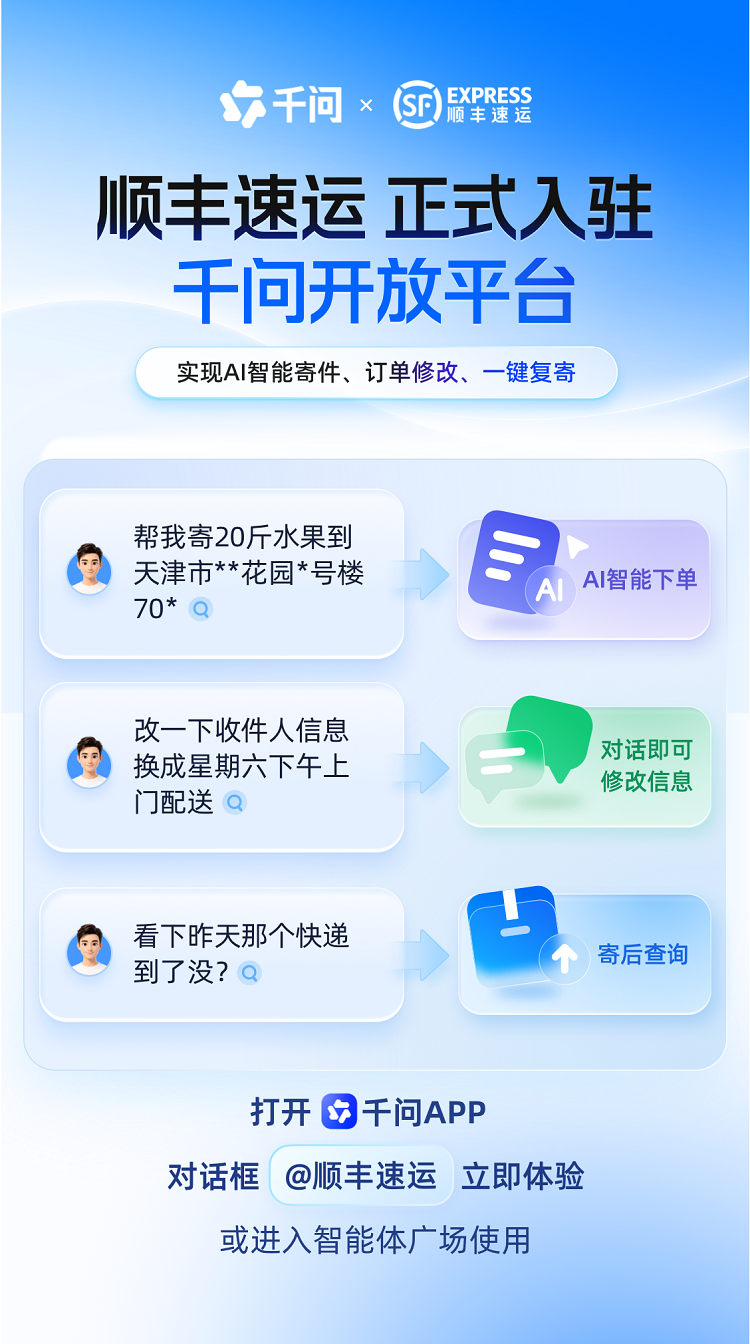
用户有寄件需求或咨询运费时效时,在“顺丰速运”智能体的对话框中直接说出需求,比如“寄一份文件到上海”、“广州寄到北京多少钱”,智能体会以功能卡片为载体,通过对话帮助用户填写地址,核验物品是否可收寄,并预估费用和送达时间,引导用户完成下单。从咨询、下单、修改到取消订单,全程可在千问对话界面内闭环完成,无需跳转外部应用。

千问内的“顺丰速运”智能体入口

一句话了解包裹动向

查件时,用户只需提供运单号、收寄件城市、收寄人姓名、包裹状态等任意信息,系统即可精准定位目标运单信息。例如询问“单号XXX快递到哪了”,智能体通过自然语言理解、结合数据自主查询,同样以功能卡片形式呈现物流轨迹,包括最新运送节点、预计送达时间等。一句话查单,信息一目了然。

顺丰持续拓宽“AI对话式快递服务”应用版图。此次入驻千问,将“想象空间”具体化。顺丰的服务正在从“工具”进化为“原生AI服务”。这不仅降低了老年人、视障群体的使用门槛,更预示着未来物流服务将不再受限于独立应用,而是无处不在的环境智能。

当前,AI大模型加速渗透至各行各业,物流作为高频、刚需的民生服务,正迎来交互方式与底层逻辑的重构。面向未来,顺丰将继续以开放姿态深化生态合作,推动服务能力向更多数字生活场景延伸,让物流数智化的便利真正融入大众日常。

注:文/龚作仁,文章来源:Laborer,本文为作者独立观点,不代表亿邦动力立场。

文章来源:Laborer

广告
微信
朋友圈

FAQ回顾

在千问平台怎么使用顺丰的寄查件服务?

用户可在千问内的“顺丰速运”智能体中通过自然对话完成寄件、查件全流程操作,无需跳转外部应用。寄件时说出需求即可引导填写地址、核验可寄性、预估费用时效并下单;查件时提供运单相关任意信息即可查询物流轨迹。

顺丰布局AI对话式快递服务有什么好处?

顺丰布局AI对话式快递服务可降低老年人、视障群体的物流服务使用门槛,同时推动物流服务摆脱独立应用限制,向无处不在的环境智能方向演进,后续还将延伸到更多数字生活场景,让智慧物流便利融入大众日常。

顺丰在AI物流服务领域有哪些布局动作?

顺丰首先在自有小程序上线自研智能体“AI小丰”,8月千问开放平台上线后,作为首批物流服务商率先完成对接,将寄查件服务以智能体形式接入千问生态,未来还将以开放姿态深化生态合作拓宽服务场景。

这么好看,分享一下?

朋友圈 分享

APP内打开

+1
+1
微信好友 朋友圈 新浪微博 QQ空间
关闭
收藏成功
发送
/140 0