广告
加载中

QM报告:即时零售用户结构打破“薅羊毛”刻板印象

龚作仁 2026-08-07 11:17
龚作仁 2026/08/07 11:17

邦小白快读

EN
全文速览

本文基于QuestMobile发布的2026中国移动互联网半年报告数据,打破了外界对即时零售用户都是薅羊毛低质量用户的刻板印象,核心干货信息如下

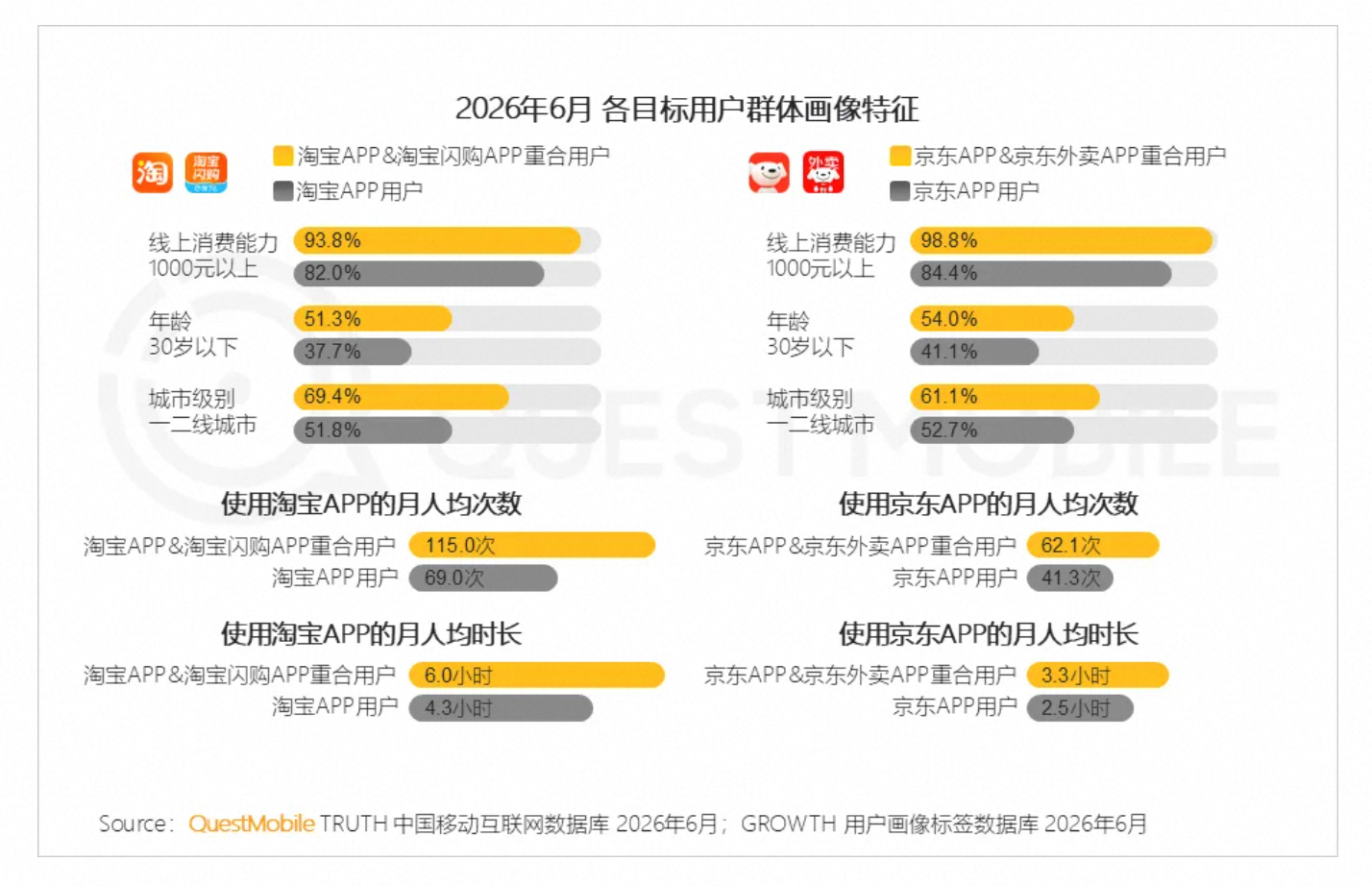
1. 披露了即时零售用户的真实质量数据,以淘宝闪购与淘宝App重合用户为例,该群体中月消费1000元以上占比93.8%,30岁以下用户占51.3%,一二线城市用户占69.4%,三项核心指标均高于普通淘宝用户,且该群体在淘宝主站的活跃度也远高于普通用户,证实即时零售不缺高价值用户。

2. 点明了即时零售行业的最新发展趋势,目前即时零售渗透仍在扩大,一至四线城市用户均实现增长,下沉市场供给不断丰富,已经延伸到多个相关行业,行业竞争重心已经从拼补贴转向拼用户运营效率与本地供给能力。

本文披露的即时零售最新行业数据与趋势,对品牌商布局即时零售、把握行业方向有较高参考价值,核心干货如下

1. 用户与消费趋势层面,打破了即时零售用户都是薅羊毛低质量人群的刻板印象,当前即时零售核心用户以年轻、高消费力、高活跃度的一二线用户为主,用户质量远高于预期,是品牌商值得深耕的优质客群,品牌商可以针对这类用户调整产品与营销策略。

2. 行业竞争与渠道层面,即时零售仍处于渗透扩张期,下沉市场供给正在丰富,全区域用户都有增长,还延伸到生鲜、美食等多个行业,竞争重心已经从补贴转向用户运营和本地供给,品牌商可以抓住下沉增量,调整布局重心,提升自身运营与供给能力。

本文披露的即时零售最新行业动向,给卖家带来了清晰的机会提示与方向指引,核心干货如下

1. 市场机会层面,即时零售目前仍处于快速渗透增长阶段,一至四线城市用户全部实现增长,下沉市场供给不断丰富,行业已经延伸到独立生鲜电商、美食服务等多个赛道,增量空间充足;头部平台阿里、京东都靠布局即时零售获得了可观的用户增量与留存,印证赛道仍有大量增长机会。

2. 策略调整与风险提示层面,行业竞争已经从补贴驱动转向用户运营效率与本地供给能力竞争,卖家要避开单纯依赖平台补贴拉新留存的旧思路,及时调整方向,重点提升自身的用户运营能力,完善本地供给匹配,抓住高价值年轻用户的需求抢占市场。

本文披露的即时零售行业新趋势,为工厂拓展销售渠道、推进数字化转型带来了多方面启示,核心干货如下

1. 商业机会层面,即时零售目前仍处于快速扩张渗透阶段,覆盖从一二线到下沉的全市场,全区域用户都实现增长,下沉市场供给还在不断丰富,行业已经延伸到生鲜、美食等多个品类,工厂可以对接即时零售平台开拓新的出货渠道,抓住即时零售带来的新增量市场。

2. 产品与转型启示层面,即时零售核心用户是年轻、高消费力的一二线群体,工厂在产品设计生产环节,可以针对性贴合这类用户的需求打造产品;同时行业竞争重心转向本地供给与用户运营,工厂可以推进数字化改造,适配即时零售快周转、贴近本地需求的要求,提升渠道适配度。

本文披露的即时零售行业发展新动向,能够帮助服务商把握行业趋势、找准服务方向,核心干货如下

1. 行业发展趋势层面,即时零售已经脱离了早期单纯依靠补贴拉新的发展阶段,进入到以用户运营效率和本地供给能力为核心竞争力的成熟发展期,目前行业渗透仍在不断扩大,下沉市场供给丰富以及多行业延伸带来了大量新增的服务需求,市场空间充足。

2. 客户痛点与服务方向层面,当前行业内品牌、商家普遍面临从补贴驱动转向运营驱动的转型痛点,核心需求是提升用户运营效率、完善本地供给能力,服务商可以围绕这两个方向开发对应解决方案,同时贴合下沉市场拓展、多行业延伸的趋势,布局对应服务产品,匹配新增需求。

本文披露的最新行业数据与趋势,对平台商布局即时零售、调整运营策略有重要参考价值,核心干货如下

1. 用户与招商层面,即时零售的用户质量远超预期,核心是高消费力、高活跃度的年轻群体,平台可以针对性优化用户运营策略深挖用户价值;目前一至四线全区域用户都实现增长,下沉市场还有较大的供给拓展空间,平台可以加大下沉市场的招商力度,丰富下沉市场供给,抢占增量。

2. 运营调整与风险规避层面,行业竞争已经从补贴力度竞争转向用户运营效率和本地供给能力竞争,平台需要及时调整战略方向,减少对补贴拉新留存的依赖,将资源倾斜到提升用户运营效率、完善本地供给能力上,规避单纯靠补贴留客的风险,同时抓住行业向多领域延伸的趋势拓展业务边界。

本文披露了QuestMobile2026年即时零售行业的最新监测数据,呈现了即时零售产业的最新发展动向,对相关领域研究有较高的参考价值,核心干货如下

1. 产业新特征层面,本文用最新数据打破了学界业界对即时零售用户的刻板印象,证实即时零售吸引的用户以高消费力、高活跃度的年轻群体为主,用户留存质量高,并非外界认为的都是依赖补贴的低质量用户;同时当前即时零售渗透仍在扩大,全区域用户均实现增长,行业溢出效应明显,已经延伸到生鲜、美食等多个相关行业。

2. 产业发展新趋势层面,即时零售已经完成初始的补贴拉新阶段,竞争重心正式转向用户运营效率和本地供给能力,商业模式从补贴驱动转向运营驱动,这一新变化为研究互联网零售产业演进路径提供了新的案例,也为研究下沉市场零售升级提供了新的观察样本。

返回默认
声明:快读内容全程由AI生成,请注意甄别信息。如您发现问题,请发送邮件至 run@ebrun.com 。

我是 品牌商 卖家 工厂 服务商 平台商 研究者 帮我再读一遍。

Quick Summary

This article draws on data from QuestMobile's 2026 China Mobile Internet Semi-Annual Report to challenge the common stereotype that instant retail users are only low-quality deal-seekers. Key takeaways are as follows:

1. It reveals verified data on the actual quality of instant retail users. Take the overlapping users of Taobao Flash Purchase and the main Taobao app as an example: 93.8% of this group spend over 1,000 yuan per month, 51.3% are under 30 years old, and 69.4% are based in first- and second-tier cities. All three core metrics outperform average Taobao users, and this group is also far more active on Taobao's main platform than average users, confirming that instant retail has no shortage of high-value users.

2. It outlines the latest development trends of the instant retail industry. Market penetration continues to expand, with user growth across all tier-1 to tier-4 cities. Supply in lower-tier下沉 markets is steadily expanding, and the industry has extended into multiple adjacent sectors. Industry competition has shifted from subsidy battles to competition over user operation efficiency and local supply capacity.

The latest industry data and trends on instant retail shared in this article offer high reference value for brands looking to enter the space and align with industry direction. Key takeaways are as follows:

1. In terms of user and consumption trends: The article breaks the stereotype that instant retail users are all low-quality deal-hunters. Today, the core user base of instant retail is primarily young, high-spending, highly active users in first- and second-tier cities, with far better user quality than commonly expected. This is a high-value customer segment worth brands' deep cultivation, and brands can adjust their product and marketing strategies to target this group.

2. In terms of industry competition and channel strategy: Instant retail is still in a period of penetration and expansion, with growing supply in下沉 markets, user growth across all regions, and expansion into multiple sectors including fresh produce and food services. Competition focus has shifted from subsidies to user operations and local supply capacity. Brands can capture incremental growth in下沉 markets, adjust their layout priorities, and strengthen their own operation and supply capabilities.

The latest industry developments on instant retail outlined in this article provide clear opportunity alerts and direction guidance for sellers. Key takeaways are as follows:

1. In terms of market opportunities: Instant retail is still in a stage of rapid penetration and growth, with user growth across all tier-1 to tier-4 cities. Supply in下沉 markets continues to expand, and the industry has extended into multiple tracks including independent fresh e-commerce and food services, leaving abundant room for incremental growth. Leading platforms including Alibaba and JD.com have both gained substantial user growth and retention via their instant retail布局, confirming that the track still holds massive growth opportunities.

2. In terms of strategy adjustment and risk alerts: Industry competition has shifted from subsidy-driven growth to competition over user operation efficiency and local supply capacity. Sellers should abandon the old approach of relying solely on platform subsidies for user acquisition and retention, adjust their direction in a timely manner, focus on improving their own user operation capabilities, and improve matching of local supply to capture demand from high-value young users and gain market share.

The new trends in the instant retail industry disclosed in this article offer multi-faceted insights for factories looking to expand sales channels and advance digital transformation. Key takeaways are as follows:

1. In terms of business opportunities: Instant retail is still in a stage of rapid expansion and penetration, covering the entire market from first- and second-tier cities to lower-tier下沉 markets, with user growth across all regions and expanding supply in下沉 markets. The industry has extended into multiple categories including fresh produce and food services. Factories can partner with instant retail platforms to open new distribution channels and capture the incremental market opportunities brought by instant retail.

2. In terms of product and transformation insights: The core user base of instant retail is young, high-spending consumers in first- and second-tier cities. Factories can tailor product design and production to meet the needs of this group. Meanwhile, as industry competition has shifted focus to local supply and user operations, factories can advance digital transformation to adapt to instant retail's requirements of fast turnover and alignment with local demand, and improve channel fit.

The new industry developments in instant retail outlined in this article can help service providers grasp industry trends and identify the right service direction. Key takeaways are as follows:

1. In terms of industry development trends: Instant retail has left behind its early stage of relying solely on subsidies for user acquisition, and entered a mature development phase where core competitiveness lies in user operation efficiency and local supply capacity. Industry penetration continues to expand, and the expansion of supply in下沉 markets and extension into multiple sectors have generated substantial new service demand, creating abundant market space.

2. In terms of client pain points and service direction: Brands and merchants across the industry are currently facing the common pain point of transforming from a subsidy-driven model to an operation-driven model, with core demand centered on improving user operation efficiency and improving local supply capacity. Service providers can develop targeted solutions around these two areas, and align their service product布局 with the trends of下沉 market expansion and cross-industry extension to meet new emerging demand.

The latest industry data and trends disclosed in this article offer important reference value for platform operators布局ing instant retail and adjusting operation strategies. Key takeaways are as follows:

1. In terms of user growth and merchant recruitment: The user quality of instant retail far exceeds expectations, with a core base of young, high-spending, highly active users. Platforms can optimize user operation strategies to unlock deeper user value. Currently, user growth has been achieved across all tier-1 to tier-4 cities, and there is still substantial room for supply expansion in下沉 markets. Platforms can step up merchant recruitment efforts in下沉 markets to enrich local supply and capture incremental growth.

2. In terms of operation adjustment and risk mitigation: Industry competition has shifted from competing on subsidy scale to competing on user operation efficiency and local supply capacity. Platforms need to adjust their strategic direction in a timely manner, reduce reliance on subsidies for user acquisition and retention, reallocate resources to improving user operation efficiency and strengthening local supply capacity, and avoid the risks of retaining users solely through subsidies. They should also capture the trend of industry expansion into multiple sectors to extend their business boundaries.

This article discloses the latest 2026 monitoring data on China's instant retail industry from QuestMobile, and presents the latest development dynamics of the instant retail sector, offering high reference value for research in related fields. Key takeaways are as follows:

1. In terms of new industry characteristics: This article uses up-to-date data to break the long-held stereotype of instant retail users held by both academia and industry. It confirms that instant retail attracts primarily high-spending, highly active young users with high retention quality, rather than the widely perceived pool of low-quality users only chasing subsidies. At the same time, instant retail penetration continues to expand, with user growth across all regions, and clear industry spillover effects as the sector has extended into multiple related fields including fresh produce and food services.

2. In terms of new industry development trends: Instant retail has completed its initial subsidy-driven user acquisition phase, and competition focus has officially shifted to user operation efficiency and local supply capacity, with the business model transitioning from subsidy-driven to operation-driven. This new shift provides a fresh case for studying the evolutionary path of the internet retail industry, and also offers a new observation sample for research on retail upgrading in下沉 markets.

Disclaimer: The "Quick Summary" content is entirely generated by AI. Please exercise discretion when interpreting the information. For issues or corrections, please email run@ebrun.com .

I am a Brand Seller Factory Service Provider Marketplace Seller Researcher Read it again.

补贴一旦退潮,用户是否会迅速流失?大规模补贴吸引来的,是否只是“喝奶茶、薅羊毛”的低质量用户?QuestMobile刚刚发布的《2026中国移动互联网半年报告》(以下简称QM报告),提供了多组2026年6月对比去年同期的最新数据,打破了“补贴一停感情归零”“留存用户多为奶茶党”等刻板印象。

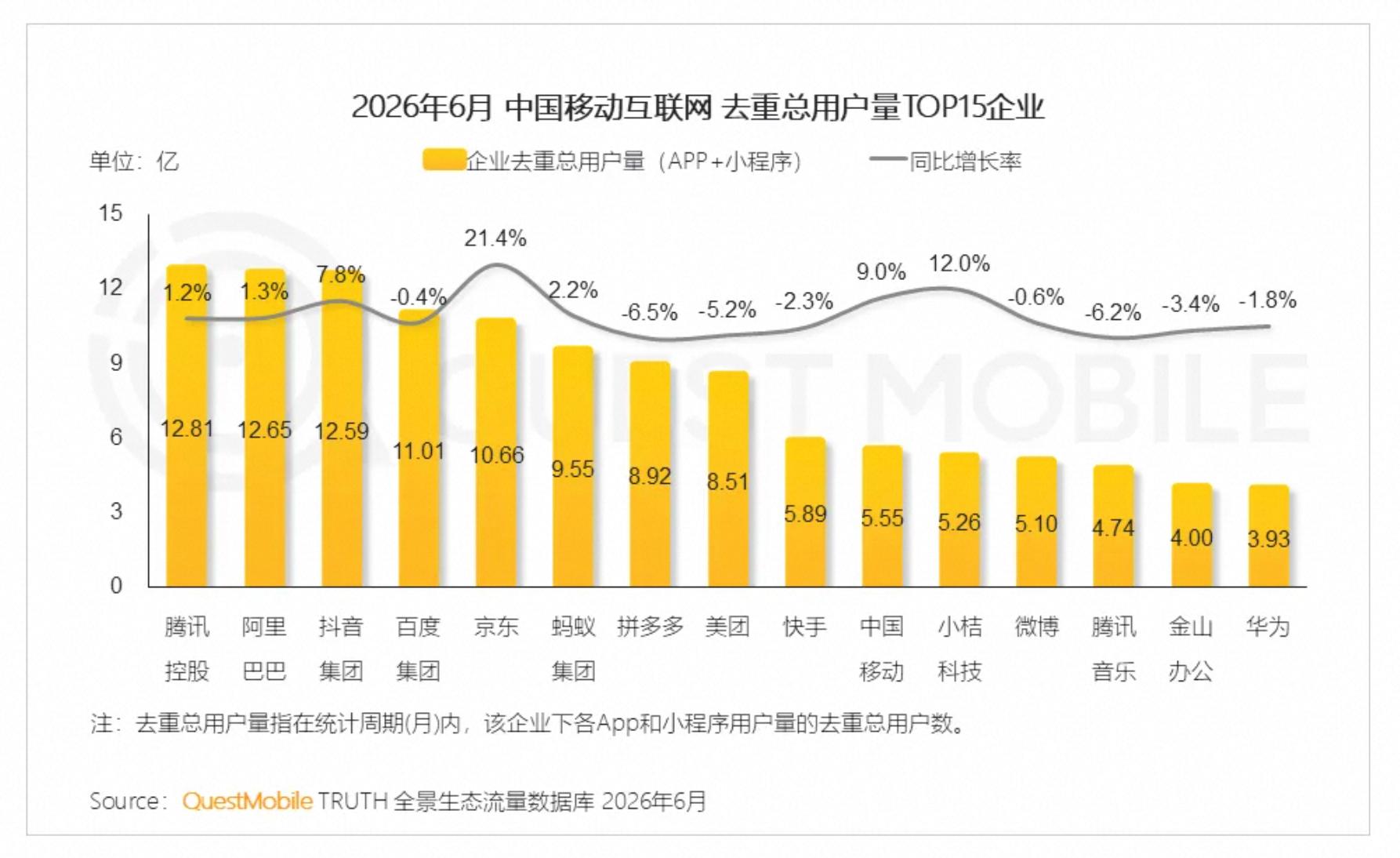
QM报告显示,过去一年,各互联网大厂的去重总用户量及排名经历了一轮洗牌,有的增有的减,其中,阿里在超高用户基数上取得进一步增长,京东的总用户规模有了大幅跃升。它们通过即时零售的深度布局,在激烈竞争中获得可观的用户增量并得以有效留存。

此外,即时零售用户的质量也高于外界预期。QM报告以淘宝闪购与淘宝App的重合用户为例,这批用户中线上月消费1000元以上的占比达93.8%,30岁以下用户占51.3%,来自一二线城市的占69.4%,三项关键指标均高于普通淘宝用户。与此同时,这部分用户在淘宝主站的月人均使用次数和使用时长也更高。

从这些多维度的数据来看,将即时零售用户简单归为“低价值人群”可能并不准确。补贴在一定程度上降低了用户尝鲜门槛,但从使用习惯和消费能力来看,即时零售所吸引的用户群体中,并不缺乏高活跃度、高消费力的年轻人。

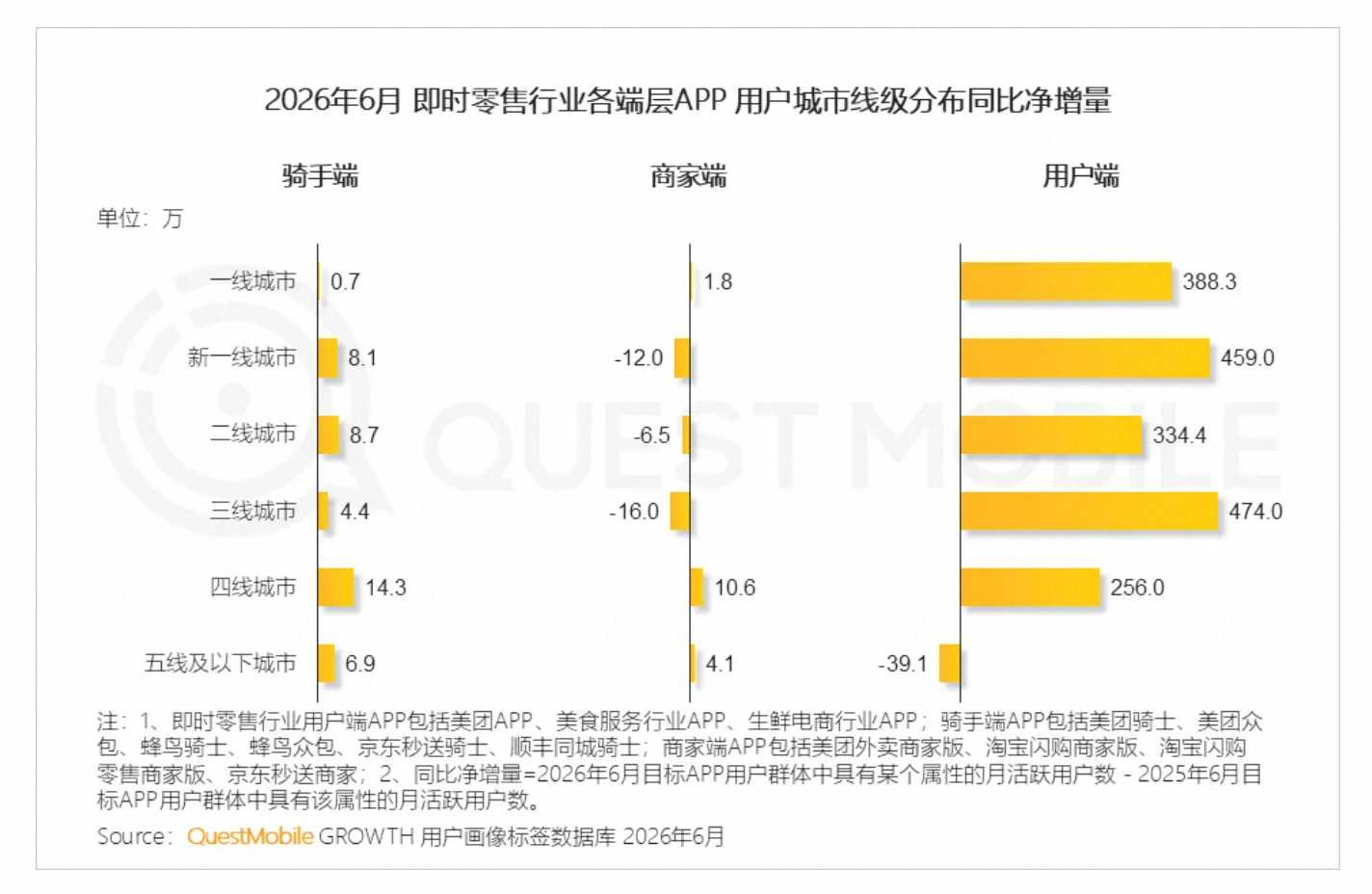
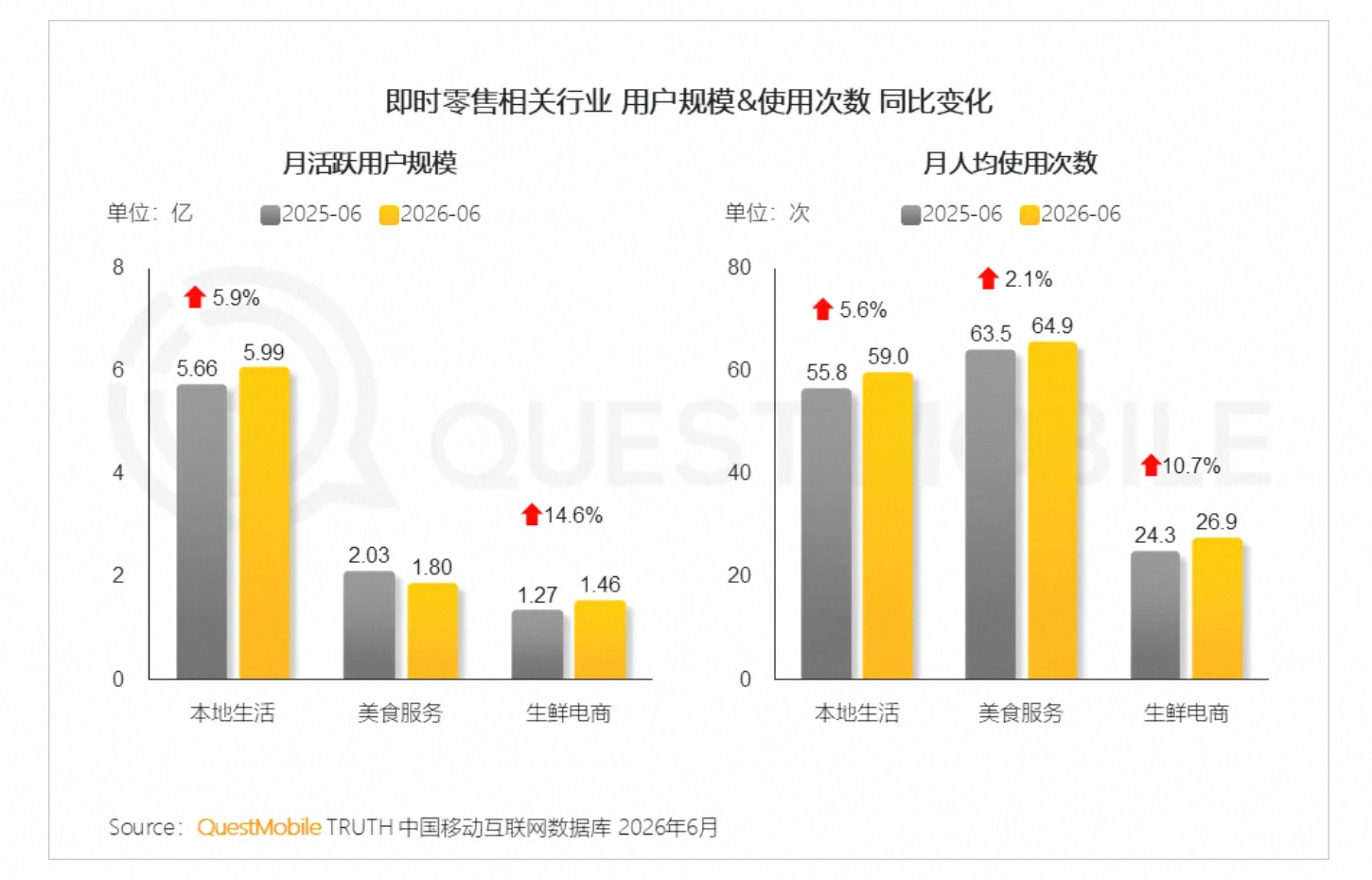
QM报告还指出,即时零售的渗透仍在扩大,一至四线城市用户均实现增长,下沉市场的供给正在丰富;同时,即时零售的普及溢出效应显现,已延伸至独立生鲜电商、美食服务等行业。

记者注意到,以上数据进一步佐证行业的趋势判断:即时零售正逐步进入日常消费场景,而非单纯依靠红包补贴驱动的单次交易行为;而即时零售的竞争重心,正在从补贴力度转向用户运营效率与本地供给能力。

注:文/龚作仁,文章来源:Laborer,本文为作者独立观点,不代表亿邦动力立场。

文章来源:Laborer

广告
微信
朋友圈

FAQ回顾

即时零售的用户都是薅羊毛的低价值群体吗?

不是。相关调研数据显示,淘宝闪购与淘宝App重合的即时零售用户中,线上月消费1000元以上占比达93.8%,30岁以下用户占51.3%,一二线城市用户占69.4%,三项指标均高于普通淘宝用户,多为高活跃度高消费力群体。

即时零售行业的竞争重心正在发生什么变化?

即时零售行业的竞争重心正在从补贴力度转向用户运营效率与本地供给能力。目前即时零售已逐步进入日常消费场景,不再单纯依靠红包补贴驱动单次交易,一至四线城市用户均实现增长,下沉市场供给也在持续丰富。

互联网平台布局即时零售有什么作用?

互联网平台通过深度布局即时零售,可在激烈的用户竞争中获得可观的用户增量并实现有效留存。目前国内互联网大厂用户排名已出现洗牌,其中京东总用户规模实现大幅跃升,阿里也在超高用户基数上取得了进一步的用户增长。

这么好看,分享一下?

朋友圈 分享

APP内打开

+1
+1
微信好友 朋友圈 新浪微博 QQ空间
关闭
收藏成功
发送
/140 0