广告
加载中

AI Agent“接管”外卖店铺运营?淘宝闪购开放MCP能力

亿邦动力 2026-08-05 11:38
亿邦动力 2026/08/05 11:38

邦小白快读

EN
全文速览

本文核心信息是淘宝闪购面向开发者和商家开放MCP能力,可接入AI Agent辅助完成店铺运营,核心干货如下:

1. 核心能力开放情况:目前淘宝闪购已上线35个MCP服务接口,覆盖商品管理、订单履约、财务、营销、经营分析等15个业务领域,能支撑多数店铺运营场景的AI调用,可帮助商家完成经营分析、商品管理、评价运营等各类工作。

2. 接入与规则干货:不同类型开发者对应不同接入方式,已接入淘宝开放平台的开发者可直接复用原有资源,无需重新开发和二次授权;安全上沿用OAuth授权,写入类操作需要商家二次确认;收费上查询功能免费,调用费用和原有API一致,2026年7月1日起进入优惠期,调用费用全免,政策调整会提前30天通知。

本文披露了电商运营智能化的最新发展动向,给品牌商家布局数字化运营提供了不少参考干货:

1. 行业运营趋势:当前AI已经深度融入商家经营环节,电商平台开放底层能力支持AI运营,智能化店铺运营将成为行业主流方向,提前布局的品牌能获得明显的效率优势,抢占市场先机。

2. 可落地的升级方向:品牌商可以通过接入AI Agent工具,实现全流程运营自动化,包括自动生成经营日报、提示经营异常、自动处理评价运营、批量管理多店商品库存价格,大幅降低运营人力成本,提升运营响应速度。

3. 接入成本利好:已经接入淘宝开放平台的品牌商家,不需要重新开发也不需要再次授权,接入门槛很低,同时还有长期的服务费优惠,试错成本极低。

对于在电商平台经营的卖家来说,本文释放了运营升级的新机会和规则信息,干货如下:

1. 机会提示:淘宝闪购开放MCP能力后,卖家可以低成本获得AI运营工具,实现全流程运营智能化,尤其适合多店、连锁卖家降本增效,解决人力不足的问题,能实现自动出经营报表、自动处理用户评价、批量调整商品信息,大幅提升运营效率。

2. 成本与规则利好:已经接入开放平台的卖家不需要重新开发,接入门槛极低;收费方面,2026年7月1日起的优惠期内,Tool调用产生的费用全免,短期内使用成本几乎为零。

3. 风险提示:使用AI进行批量修改商品、调整库存等写入操作时,初期必须经过卖家二次确认,卖家要做好操作校验,避免AI误操作带来经营损失。

对于布局电商业务的生产工厂来说,本文带来了数字化升级的新启示和商业机会,干货如下:

1. 商业机会:如果工厂拥有自有线上销售店铺,可以借助第三方开发的AI Agent工具实现运营自动化,解决工厂普遍存在的线上运营人力不足、专业能力不够的问题,尤其是多SKU、多店铺的工厂,能大幅提升批量管理商品、库存的效率,降低运营成本。

2. 数字化转型启示:电商平台开放全链路AI能力后,工厂推进电商数字化的门槛大幅降低,不需要投入大量资金自研系统,就能低成本用上成熟的智能化运营工具,加快自身数字化转型进度。

3. 产品端价值:AI工具可以快速整合经营数据、用户评价信息,帮助工厂更快感知市场需求变化,及时调整产品生产和设计方向,更好贴合市场需求。

对于电商领域的SaaS服务商、技术服务商来说,本文披露了行业新趋势和新的业务机会,干货如下:

1. 行业发展趋势:AI赋能商家运营是接下来电商服务领域的核心增长点,平台开放底层业务能力,为服务商开发AI商家工具扫清了基础障碍,行业进入快速发展阶段,新入场者也有较大增长空间。

2. 当前客户核心痛点:中小商家都有降本增效的需求,对能替代人工完成重复运营工作的智能化工具需求强烈,市场缺口较大,尚未出现完全饱和的竞争状态。

3. 可落地的业务方向:服务商可以基于淘宝闪购开放的35个覆盖15个业务领域的MCP接口,开发不同类型的AI工具,比如AI店长助手、AI评价运营工具、AI批量商品管理工具等,满足商家不同场景的需求。

4. 成本利好:原有接入淘宝开放平台的服务商可以直接复用原有资源,不需要重新开发,还有服务费优惠,开发和运营成本都很低。

对于各类电商平台来说,本文披露了头部平台在AI生态布局上的最新做法,有不少参考干货:

1. 商家和开发者的核心需求:当前商家对AI智能化运营工具需求强烈,开发者需要平台开放底层业务能力才能开发可用的AI产品,平台开放能力是完善AI生态、留住商家的基础。

2. 可参考的最新运营做法:淘宝闪购沿用原有开放平台的授权体系,降低开发者接入门槛,同时保留成熟的OAuth安全授权机制,对写入类操作要求商家二次确认,平衡了便捷性和安全性;收费上通过优惠期政策吸引开发者入驻,降低开发者起步成本。

3. 风向规避参考:开放AI能力需要做好安全机制,明确授权的可管理性,要求开发者对高危操作增加二次确认,降低AI误操作给商家带来的风险,同时提前明确收费规则和政策调整通知机制,避免产生平台与开发者、商家之间的纠纷。

对于电商产业和AI应用领域的研究者来说,本文披露了AI落地实体经营的最新产业动向,有不少研究价值的干货:

1. 产业新动向:AI已经从通用技术落地到电商店铺运营的具体场景,电商平台开始系统性开放底层业务能力给AI Agent,探索出了AI赋能中小商家的新路径,标志着电商行业AI化进入落地发展的新阶段。

2. 新商业模式:目前已经形成了“平台开放底层业务接口+第三方开发者开发AI工具+商家使用”的新生态商业模式,平台输出能力和规则,第三方提供产品,既丰富了平台生态,也给开发者带来新的增长机会,是一种值得深入研究的新产业分工模式。

3. 政策设计启示:平台开放AI能力时,复用原有授权体系降低接入门槛、通过优惠期吸引开发者、用二次确认机制管控风险的设计思路,对后续同类平台开放能力的规则设计有较高参考价值,值得进一步研究总结。

返回默认

声明:快读内容全程由AI生成,请注意甄别信息。如您发现问题,请发送邮件至 run@ebrun.com 。

我是 品牌商 卖家 工厂 服务商 平台商 研究者 帮我再读一遍。

Quick Summary

This article covers Taobao Flash Sale’s opening of its MCP capabilities to developers and merchants, enabling integration of AI Agents to assist with store operations. Key takeaways are as follows:

1. Open core capabilities: Taobao Flash Sale has currently launched 35 MCP service APIs covering 15 business domains including product management, order fulfillment, finance, marketing and business analytics. These APIs support AI invocation for most store operation scenarios, enabling AI to assist merchants with business analysis, product management, review management and other operational tasks.

2. Access and rules: Different types of developers follow different access procedures. Developers already integrated with the Taobao Open Platform can directly reuse their existing resources without additional redevelopment or secondary authorization. Security follows the existing OAuth framework, and write operations require secondary confirmation from merchants. For pricing, query functions are free, and invocation fees align with existing API pricing. From July 1, 2026, all invocation fees will be waived during a preferential period, and any policy adjustments will be announced 30 days in advance.

This article outlines the latest developments in intelligent e-commerce operations, offering valuable insights for brand merchants building out digital operations capabilities:

1. Industry operation trend: AI has become deeply integrated into merchant operations, and e-commerce platforms are now opening their underlying capabilities to support AI-powered operations. Intelligent store operation will become the industry mainstream, and brands that adopt this transformation early will gain clear efficiency advantages and first-mover advantage in the market.

2. Actionable upgrade paths: Brand merchants can integrate AI Agent tools to automate end-to-end operations, including automatic generation of daily business reports, alerts for operational anomalies, automated review management, and bulk management of inventory and pricing across multiple stores. This will significantly reduce labor costs for operations and improve response speed.

3. Favorable access costs: Brand merchants already integrated with the Taobao Open Platform face no requirements for redevelopment or re-authorization, resulting in very low access barriers, plus long-term service fee discounts that keep trial costs minimal.

For sellers operating on e-commerce platforms, this article outlines new opportunities for operational upgrades and clarifies key rule details. Key takeaways are as follows:

1. Opportunity alert: Following Taobao Flash Sale’s opening of MCP capabilities, sellers can gain access to AI-powered operation tools at low cost to achieve full-process intelligent operation. This is particularly suitable for multi-store and chain sellers looking to cut costs and improve efficiency, addressing labor shortages. It enables automated generation of business reports, automated customer review processing, and bulk editing of product information, greatly boosting operational efficiency.

2. Favorable costs and rules: Sellers already integrated with the open platform do not need redevelopment, resulting in extremely low access barriers. For pricing, all Tool invocation fees are waived during the preferential period starting July 1, 2026, bringing near-zero usage costs in the near term.

3. Risk alert: For AI-powered write operations such as bulk product edits and inventory adjustments, secondary seller confirmation is mandatory for now. Sellers should conduct operational checks to avoid business losses from AI misoperation.

For manufacturing factories with their own e-commerce businesses, this article offers new insights for digital upgrading and new business opportunities. Key takeaways are as follows:

1. Business opportunities: Factories that operate their own online stores can leverage third-party developed AI Agent tools to automate operations, solving common pain points for factories including insufficient labor and limited professional expertise for online operations. For factories managing multiple SKUs across multiple stores in particular, this can greatly improve efficiency for bulk product and inventory management and reduce operational costs.

2. Insights for digital transformation: The opening of end-to-end AI capabilities by e-commerce platforms has drastically lowered the barrier for factories to advance e-commerce digitalization. Factories do not need to invest heavily in self-developed systems to access mature intelligent operation tools at low cost, accelerating their digital transformation progress.

3. Product-side value: AI tools can quickly integrate operational data and customer review information to help factories faster identify shifts in market demand, and adjust product production and design in a timely manner to better align with market needs.

For SaaS and technology service providers in the e-commerce industry, this article discloses new industry trends and new business opportunities. Key takeaways are as follows:

1. Industry development trend: AI-powered merchant operations will be the core growth area for the e-commerce services sector in the coming period. By opening underlying business capabilities, platforms have cleared core obstacles for service providers to develop AI-powered merchant tools, and the industry has entered a period of rapid growth with considerable room for new entrants to expand.

2. Core pain points of current customers: Small and medium-sized merchants have widespread demand for cost reduction and efficiency improvement, and there is strong demand and a large market gap for intelligent tools that can replace manual labor for repetitive operational tasks. The market is not yet fully saturated.

3. Actionable business directions: Service providers can develop AI tools for different use cases based on Taobao Flash Sale’s 35 MCP APIs covering 15 business domains, such as AI store manager assistants, AI review operation tools, and AI bulk product management tools, to meet merchant demand across different scenarios.

4. Favorable costs: Service providers already integrated with the Taobao Open Platform can directly reuse existing resources without redevelopment, and also qualify for service fee discounts, keeping both development and operational costs low.

For other e-commerce platforms, this article introduces the latest practices of a leading platform in AI ecosystem building, offering valuable reference insights. Key takeaways are as follows:

1. Core demands of merchants and developers: Merchants currently have strong demand for AI intelligent operation tools, and developers need platforms to open underlying business capabilities to build functional AI products. Opening platform capabilities is the foundation for improving AI ecosystems and retaining merchants.

2. Referenceable latest operational practices: Taobao Flash Sale reused the existing open platform authorization system to lower access barriers for developers, while retaining the mature OAuth security authorization mechanism and requiring secondary merchant confirmation for write operations, striking a balance between convenience and security. For pricing, it uses preferential period policies to attract developer onboarding and lower developer starting costs.

3. Guidance for risk mitigation: Opening AI capabilities requires robust security mechanisms and clear authorization manageability. Developers should be required to add secondary confirmation for high-risk operations to reduce the risk of business losses for merchants from AI misoperation. Platforms should also clarify pricing rules and policy adjustment notification mechanisms in advance to avoid disputes between the platform, developers and merchants.

For researchers focused on e-commerce industry and AI applications, this article discloses the latest industry developments in the practical application of AI to physical business operations, with considerable research value. Key insights are as follows:

1. New industry developments: AI has moved from generic technology to practical deployment in specific e-commerce store operation scenarios. E-commerce platforms are now systematically opening underlying business capabilities to AI Agents, exploring a new path for AI to empower small and medium-sized merchants. This marks that AI adoption in the e-commerce industry has entered a new phase of落地 development.

2. New business model: A new ecological business model has been formed: "platform opens underlying business APIs + third-party developers build AI tools + merchants use the tools". In this model, the platform provides capabilities and rules, while third parties deliver products. This enriches the platform ecosystem and creates new growth opportunities for developers, making it a new industry division model worthy of in-depth research.

3. Insights for policy design: The design approaches adopted when opening AI capabilities — reusing existing authorization systems to lower access barriers, attracting developers through preferential periods, and controlling risk via secondary confirmation mechanisms — offer high reference value for rule design for similar platform capability opening initiatives in the future, and are worthy of further research and summary.

Disclaimer: The "Quick Summary" content is entirely generated by AI. Please exercise discretion when interpreting the information. For issues or corrections, please email run@ebrun.com .

I am a Brand Seller Factory Service Provider Marketplace Seller Researcher Read it again.

【亿邦原创】日前,淘宝闪购向服务商和自研系统商家开放MCP(Model Context Protocol)能力。

通过这一能力,已接入开放平台的开发者可以将淘宝闪购的商品、订单、营销、财务等经营能力接入AI Agent(智能体),让AI应用在获得商家授权后调用平台能力,辅助商家完成经营分析、商品管理、评价运营等工作。


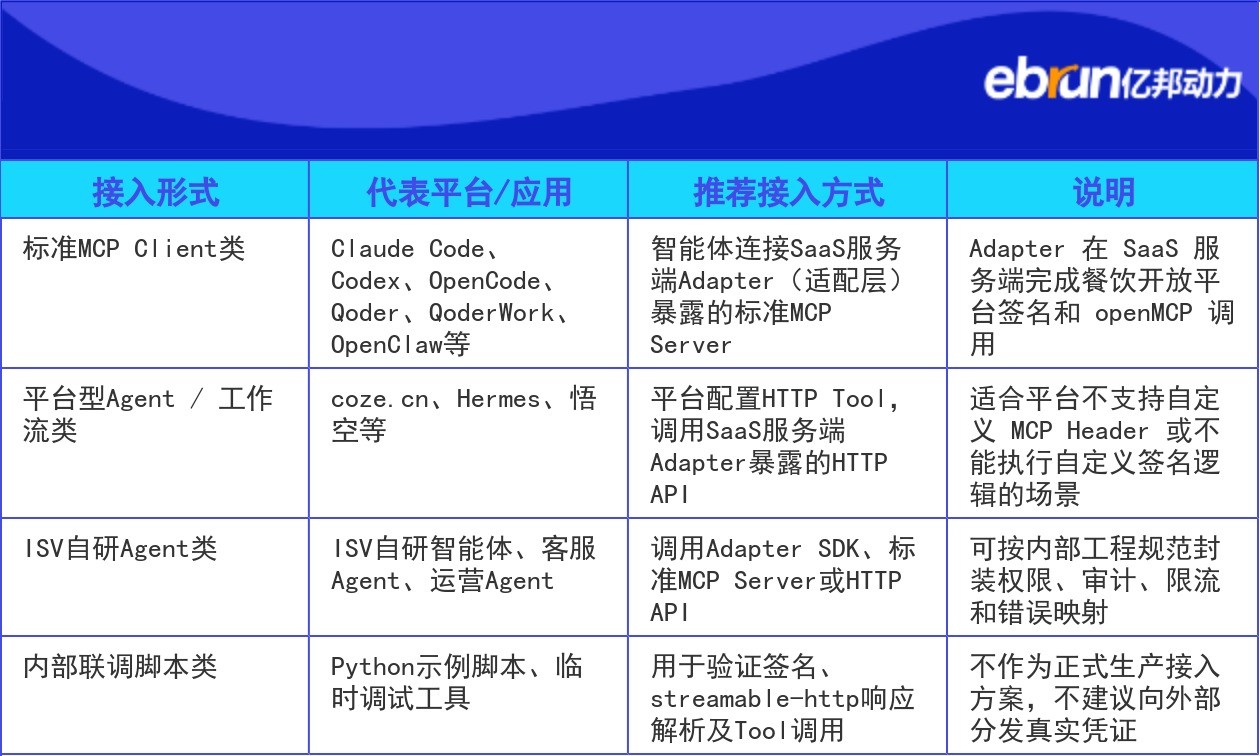
接入形式 代表平台/应用 推荐接入方式 说明
标准MCP Client类 Claude Code、Codex、OpenCode、Qoder、QoderWork、OpenClaw等 智能体连接SaaS服务端Adapter(适配层)暴露的标准MCP Server Adapter 在 SaaS 服务端完成餐饮开放平台签名和 openMCP 调用
平台型Agent / 工作流类 coze.cn、Hermes、悟空等 平台配置HTTP Tool,调用SaaS服务端Adapter暴露的HTTP API 适合平台不支持自定义 MCP Header 或不能执行自定义签名逻辑的场景
ISV自研Agent类 ISV自研智能体、客服Agent、运营Agent 调用Adapter SDK、标准MCP Server或HTTP API 可按内部工程规范封装权限、审计、限流和错误映射
内部联调脚本类 Python示例脚本、临时调试工具 用于验证签名、streamable-http响应解析及Tool调用 不作为正式生产接入方案,不建议向外部分发真实凭证

目前,淘宝闪购已上线35个MCP Server(基于MCP协议开放的业务能力服务接口),覆盖商品与菜单、订单与履约、财务与账单、评价互动、营销活动等15个业务领域。

其中,商品与菜单领域开放商品信息查询、商品编辑管理、商品上下架、库存管理、商品分类管理等8项能力;订单与履约领域支持订单查询、配送信息查询、退款与索赔查询等功能;财务领域支持订单账单余额账单、单店账单等查询;营销领域则开放优惠券查询、营销活动查询、拼团商品管理等能力;经营分析领域开放生意参谋经营分析、发票查询、商家投诉查询、短信发送结果查询。

基于这些开放能力,服务商和SaaS厂商可以搭建不同类型的AI商家工具。例如,AI店长助手可以调用经营分析、店铺评分、账单等能力,自动生成经营日报并提示异常波动;AI评价运营工具可以结合评价查询、批量回复和优惠券能力,实现评价运营自动化;AI商品管理工具则可以通过商品上下架、批量改价、库存调整等能力,辅助连锁商家进行批量运营。

安全机制方面,淘宝闪购继续采用开放平台原有OAuth授权机制(第三方应用访问平台数据时,需要经过商户授权的安全认证流程),商户授权关系支持查询、管理和解除。对于涉及批量修改商品、库存等写入操作的能力,开发者需要设计商户二次确认机制,稳定运行3个月后可向平台申请取消二次确认。

在接入方式上,淘宝闪购沿用了开放平台原有的应用和商户授权体系。已经接入开放平台的开发者,可以直接复用已有应用、接口权限和商户授权关系,无需重新开发,也无需商户再次授权。

收费方面,淘宝闪购表示,Tool列表查询功能免费,具体Tool调用收费规则与对应API接口保持一致。在技术服务费优惠期内,开发者通过Tool调用产生的费用将在月账单中免除。该优惠期自2026年7月1日起计算,后续截止时间及政策调整将提前30天进行通知。

随着AI应用逐渐进入商家经营环节,淘宝闪购正在通过开放底层业务能力,让第三方开发者和服务商能够基于平台数据和交易能力开发更多智能化工具。

亿邦持续追踪报道该情报,如想了解更多与本文相关信息,请扫码关注作者微信。

文章来源:亿邦动力

广告
微信
朋友圈

FAQ回顾

淘宝闪购开放的MCP能力有什么作用?

淘宝闪购开放的MCP能力可让获得商家授权的AI Agent调用平台商品、订单、营销、财务等经营能力,辅助商家完成经营分析、商品管理、评价运营等工作,服务商也可基于该能力搭建不同类型的AI商家工具。

接入淘宝闪购MCP能力的收费规则是什么?

淘宝闪购MCP能力的Tool列表查询功能免费,具体Tool调用收费规则与对应API接口保持一致。2026年7月1日起进入技术服务费优惠期,优惠期内开发者调用产生的费用将在月账单中免除,后续政策调整将提前30天通知。

淘宝闪购MCP能力覆盖哪些业务领域?

目前淘宝闪购已上线35个MCP Server,覆盖商品与菜单、订单与履约、财务与账单、评价互动、营销活动、经营分析等15个业务领域,可满足商家多维度的经营操作需求。

基于淘宝闪购MCP能力可以开发哪些AI商家工具?

基于该能力可开发AI店长助手,自动生成经营日报并提示异常波动;可打造AI评价运营工具,实现评价运营自动化;可开发AI商品管理工具,辅助连锁商家完成批量上下架、改价、调库存等操作。

这么好看,分享一下?

朋友圈 分享

APP内打开

赞 +1
+1
微信好友 朋友圈 新浪微博 QQ空间
关闭
收藏成功
发送
/140 0