广告
加载中

入选亿邦智库报告 燕文物流创新跨境直达与海外最后一公里

亿邦智库 2026-07-30 11:30
亿邦智库 2026/07/30 11:30

邦小白快读

EN
全文速览

本文核心信息是杭州第十届全球跨境电商峰会上,亿邦智库发布了最新行业报告,点明跨境电商与跨境物流的新发展趋势,同时收录了燕文物流的创新实践,核心干货如下

1.本次峰会有柳冠中、江南春等千位行业代表出席,报告首次提出产品AI化的“增强、幻觉和创物”路径,提出品类场景化细分机会、品牌生态化复制逻辑,还提出AI×(海外仓+直达)的全球物流双螺旋网络新结构。

2.行业核心判断:海外仓与跨境直达将长期互补共存,海外仓适合成熟爆款、中大件欧美市场本地化运营,跨境直达适合新品测款、长尾小件、新兴市场冷启动,预测跨境直达未来将占据30%的常态市场份额。

3.燕文物流创新实践:推出全球专线直发加美国本土最后一公里派送协同模式,全球覆盖广,尾程运营平衡了服务控制力与成本效率,适配行业新趋势需求。

本次峰会及报告为出海品牌梳理了物流供应链升级方向,明确了消费趋势与落地适配方案,核心干货如下

1.行业与消费趋势:当前全球化新品牌竞争已经进入精细化阶段,品牌物流需求从“能不能发出去”转向“能不能按品类、市场、经营周期及成本多元适配履约方式”,单一履约模式无法覆盖全部场景,多元组合调配能力已经成为品牌全球化供应链的核心能力。

2.差异化物流适配逻辑:成熟爆款、中大件商品深耕欧美主流市场适配海外仓,新品测款、长尾小件、季节性快反商品、新兴市场冷启动适配跨境直达,两种模式组合可同时兼顾成本、时效、物流可视化、末端售后多重诉求。

3.可参考的合作伙伴:燕文物流的双业务协同模式覆盖全球200多个国家和地区,美国尾程覆盖约70%人口,可满足品牌全球化的差异化物流需求,支撑品牌布局全球市场。

本次峰会发布的报告为跨境出海卖家解读了物流行业新趋势,明确了市场机会与风险提示,核心干货如下

1.物流行业新趋势:未来海外仓与跨境直达将长期共存互补,亿邦智库预测跨境直达有望形成占跨境物流30%的常态份额,市场空间稳定,卖家需要根据自身业务特征调整物流布局。

2.不同场景的适配方案:成熟爆款、中大件商品深耕欧美主流市场,选择海外仓更适配;做新品测款、布局长尾小件、季节性快反商品、拓展新兴市场冷启动,选择跨境直达更具优势,能控制成本降低风险。

3.机会与风险提示:单一物流履约模式已经无法覆盖全场景需求,卖家需要提升多元组合调配物流模式的能力;燕文物流的全球直发加本土尾程协同模式,兼具服务控制力与成本优势,可以作为靠谱的物流合作伙伴选择,支撑卖家多场景业务需求。

本次峰会发布的报告给出海工厂明确了业务拓展方向,梳理了物流适配需求与商业机会,核心干货如下

1.市场需求变化:当前全球化新品牌竞争进入精细化阶段,工厂出海不管是做代工还是做自有品牌,都需要匹配差异化的物流履约能力,单一发货模式已经无法满足不同阶段不同市场的需求,物流能力直接影响出海竞争力。

2.不同发展阶段的商业机会:工厂出海测试新品、拓展长尾品类、布局新兴市场的时候,可以选择跨境直达控制库存与物流成本,模式更灵活;做成成熟爆款、深耕欧美成熟市场的时候,可以搭配海外仓做本地化运营,提升用户体验。

3.数字化与出海启示:燕文物流的全球覆盖能力加美国本土尾程派送的协同模式,可以支撑工厂出海不同阶段的差异化需求,工厂出海要重视物流供应链布局,根据不同业务场景组合两种履约模式,平衡成本与用户体验,提升自身出海竞争力。

本次峰会发布的报告明确了跨境物流服务行业的发展趋势,梳理了客户痛点与可参考的创新解决方案,核心干货如下

1.行业发展新趋势:未来跨境物流将形成AI×(海外仓+跨境直达)塑造的全球物流供应链双螺旋网络,海外仓与跨境直达长期互补共存,跨境直达有望占到跨境物流30%的常态份额,仍然有不可替代的市场空间。

2.核心客户痛点:当前出海品牌同时兼顾成本、时效、物流可视化、末端售后多重诉求,还需要适配不同品类、不同市场、不同经营周期的差异化物流需求,单一履约模式无法满足客户的全场景需求。

3.可参考的创新解决方案:燕文物流的“全球专线跨境直发+美国本土最后一公里派送”双业务协同模式,适配行业新趋势;美国尾程采用“分拣中心全自营+尾程派送灵活外包”的混合模型,在服务控制力和成本效率之间找到最优平衡,这类创新模式值得同行参考。

本次峰会发布的报告明确了商家对物流平台服务的新需求,点明了平台未来布局方向与风险规避要点,核心干货如下

1.商家对平台物流服务的新需求:当前出海商家已经不满足单一的物流履约方式,需要平台提供能适配不同品类、不同市场、不同经营周期的多元化物流选择,才能支撑商家全场景业务布局,提升商家出海竞争力。

2.平台可布局的方向:平台可以依托现有生态,引入兼具跨境直达能力和本土末端派送能力的物流服务商,丰富平台的物流服务矩阵,满足商家差异化需求,提升平台对商家的吸引力,助力招商拓展。

3.风向规避提示:未来物流履约的适配能力直接影响品牌商家出海的竞争力,平台需要及时调整物流生态布局,跟进AI重构跨境服务的新趋势,打造海外仓加跨境直达互补的物流服务体系,规避单一物流模式无法满足需求的风险,提升平台整体竞争力。

本次峰会上亿邦智库发布的报告提出了跨境电商领域多个新观点、新动向,还给出了创新商业模式样本,核心干货如下

1.领域新观点:报告首次提出产品AI化的“增强、幻觉和创物”路径,提出了品类场景化细分机会、品牌生态化复制逻辑,系统梳理了跨境电商催生的全球化新品牌物种爆发路径与趋势;还首次提出AI×(海外仓+直达)塑造全球物流供应链双螺旋网络的新结构。

2.产业新动向:明确海外仓与跨境直达会长期共存互补,预测跨境直达将形成占跨境物流30%的常态份额,依然有不可替代的价值;指出当前全球化新品牌竞争已经进入精细化阶段,对物流履约的多元化适配能力要求大幅提升,物流能力直接影响品牌出海竞争力。

3.创新商业模式样本:燕文物流作为老牌跨境物流企业,创新推出全球专线直发加本土末端派送双业务协同模式,末端采用自营分拣加灵活外包的混合运营模式,是适配新趋势的创新物流商业模式,具有研究价值。

返回默认

声明:快读内容全程由AI生成,请注意甄别信息。如您发现问题,请发送邮件至 run@ebrun.com 。

我是 品牌商 卖家 工厂 服务商 平台商 研究者 帮我再读一遍。

Quick Summary

This article summarizes key takeaways from the 10th Global Cross-Border E-Commerce Summit in Hangzhou, where Yibang Institute released its latest industry report outlining new development trends in cross-border e-commerce and cross-border logistics, along with a case study on the innovative practices of Yanwen Logistics. Core insights are as follows:

1. The summit gathered 1,000 industry representatives including Liu Guanzhong and Jiang Nanchun. The report for the first time proposes the "Enhancement, Hallucination, Creation" path for AI-powered product development, highlights segmentation opportunities from scenario-based category positioning and the logic of ecosystem-driven brand scaling, and introduces the new dual-helix global logistics network structure of AI × (Overseas Warehouse + Direct Shipping).

2. Core industry judgment: Overseas warehouses and cross-border direct shipping will coexist and complement each other long term. Overseas warehouses are optimal for localized operations of mature best-selling products and medium/large items in the European and U.S. markets, while direct shipping fits new product testing, small long-tail items, and cold starts in emerging markets. The report forecasts that cross-border direct shipping will eventually claim a steady 30% market share in the long run.

3. Yanwen Logistics' innovative practice: The company launched a coordinated model combining global dedicated line direct shipping and last-mile delivery via local U.S. providers. It boasts broad global coverage, and its last-mile operations strike a balance between service control and cost efficiency, making it well-aligned with the new industry trends.

This summit and its accompanying report help global-focused brands map out the upgrading direction for their logistics and supply chains, and clarify consumer trends and actionable adaptation solutions. Core takeaways are as follows:

1. Industry and consumer trends: The competition among new global brands has entered a stage of refined operations. Brand logistics needs have shifted from "can we ship it out" to "can we match fulfillment methods based on category, market, business cycle and diverse cost requirements." A single fulfillment model can no longer cover all operational scenarios, and the ability to deploy mixed fulfillment models has become a core capability for globalized brand supply chains.

2. Differentiated logistics adaptation logic: Mature best-selling products and medium/large items targeting mainstream European and U.S. markets are best suited for overseas warehouses, while new product testing, small long-tail items, seasonal fast-response goods, and cold starts in emerging markets fit cross-border direct shipping better. A combination of the two models can simultaneously meet multiple requirements including cost, delivery speed, logistics visibility, and end-to-end after-sales service.

3. Recommended logistics partner: Yanwen Logistics' dual-model coordinated operation covers more than 200 countries and regions, with last-mile coverage of roughly 70% of the U.S. population. It can meet brands' differentiated logistics needs for global expansion and support brands' global market布局.

The report released at the summit interprets new trends in the logistics industry for cross-border sellers, and clarifies market opportunities and risk warnings. Core insights are as follows:

1. New logistics industry trends: Overseas warehouses and cross-border direct shipping will coexist and complement each other long term. Yibang Institute forecasts that cross-border direct shipping will eventually hold a steady 30% share of the cross-border logistics market, with stable market space. Sellers need to adjust their logistics布局 according to their own business characteristics.

2. Adaptation solutions for different scenarios: For mature best-selling products and medium/large items targeting mainstream European and U.S. markets, overseas warehouses are the better fit. For new product testing, small long-tail items, seasonal fast-response goods, and cold starts in emerging markets, cross-border direct shipping offers greater advantages in cost control and risk reduction.

3. Opportunity and risk warnings: A single logistics fulfillment model can no longer cover all scenario-based needs. Sellers need to improve their ability to deploy mixed logistics models. Yanwen Logistics' coordinated model of global direct shipping plus local last-mile delivery offers both strong service control and cost advantages, making it a reliable logistics partner that can support sellers' multi-scenario business needs.

The report released at the summit clarifies business expansion directions for export-focused factories, and sorts out logistics adaptation needs and business opportunities. Core insights are as follows:

1. Shifts in market demand: Competition among new global brands has entered a stage of refined operations. Whether factories are engaged in OEM or building their own brands for global expansion, they need to match differentiated logistics fulfillment capabilities. A single shipping model can no longer meet the needs of different development stages and different markets, and logistics capability directly impacts a factory's global competitiveness.

2. Business opportunities for different development stages: When factories test new products, expand long-tail categories, or enter emerging markets, cross-border direct shipping is a better choice to control inventory and logistics costs with greater flexibility. When factories have developed mature best-selling products and are deepening their presence in mature European and U.S. markets, they can pair this with overseas warehouses for localized operations to improve user experience.

3. Implications for digitalization and global expansion: Yanwen Logistics' coordinated model of global coverage plus local U.S. last-mile delivery can support the differentiated needs of factories at different stages of global expansion. Factories expanding globally should prioritize logistics supply chain布局, combine the two fulfillment models based on different business scenarios to balance cost and user experience, and improve their overall competitiveness.

The report released at the summit clarifies development trends for the cross-border logistics service industry, and sorts out customer pain points and referenceable innovative solutions. Core insights are as follows:

1. New industry development trends: The future cross-border logistics industry will form a dual-helix global logistics supply chain network shaped by AI × (Overseas Warehouse + Cross-Border Direct Shipping). Overseas warehouses and cross-border direct shipping will coexist and complement each other long term, and cross-border direct shipping is expected to hold a steady 30% share of the cross-border logistics market, retaining irreplaceable market space.

2. Core customer pain points: Current global-focused brands need to simultaneously balance multiple requirements: cost, delivery speed, logistics visibility, and end-to-end after-sales service. They also need differentiated logistics solutions to match different categories, different markets, and different business cycles. A single fulfillment model cannot meet customers' full-scenario needs.

3. Referenceable innovative solution: Yanwen Logistics' dual-business coordinated model of "global dedicated line cross-border direct shipping + local U.S. last-mile delivery" is well aligned with new industry trends. Its U.S. last-mile operations adopt a hybrid model of "fully self-operated sorting centers + flexible outsourced last-mile delivery," which strikes an optimal balance between service control and cost efficiency. This type of innovative model is a valuable reference for industry peers.

The report released at the summit clarifies merchants' new demands for logistics platform services, and points out the future布局 direction and risk mitigation priorities for platforms. Core insights are as follows:

1. Merchants' new demands for platform logistics services: Current global-focused merchants are no longer satisfied with a single logistics fulfillment model. They need platforms to provide diversified logistics options that can adapt to different categories, different markets, and different business cycles, to support merchants' full-scenario business布局 and improve their global competitiveness.

2. Priorities for platform布局: Platforms can leverage their existing ecosystems to introduce logistics providers with both strong cross-border direct shipping capabilities and local last-mile delivery capabilities, to enrich the platform's logistics service matrix, meet merchants' differentiated needs, improve the platform's appeal to merchants, and support merchant acquisition and expansion.

3. Risk mitigation guidance: The ability to adapt logistics fulfillment to different needs will directly impact the competitiveness of brand merchants going global. Platforms need to adjust their logistics ecosystem布局 in a timely manner, follow the new trend of AI-driven restructuring of cross-border services, build a complementary logistics service system combining overseas warehouses and cross-border direct shipping, avoid the risk of being unable to meet demand with a single logistics model, and improve the platform's overall competitiveness.

The report released by Yibang Institute at the summit puts forward multiple new viewpoints and trends in the cross-border e-commerce sector, and provides an innovative business model sample. Core insights are as follows:

1. New sectoral viewpoints: The report for the first time proposes the "Enhancement, Hallucination, Creation" path for AI-powered product development, outlines segmentation opportunities from scenario-based category positioning and the logic of ecosystem-driven brand scaling, systematically sorts out the outbreak path and trends of new global brand species spawned by cross-border e-commerce, and for the first time introduces the new dual-helix global logistics supply chain network structure shaped by AI × (Overseas Warehouse + Direct Shipping).

2. New industry trends: The report clarifies that overseas warehouses and cross-border direct shipping will coexist and complement each other long term, and forecasts that cross-border direct shipping will eventually hold a steady 30% share of the cross-border logistics market, retaining irreplaceable value. It points out that competition among new global brands has entered a stage of refined operations, which has greatly increased demand for diversified and adaptable logistics fulfillment capabilities, and logistics capability directly impacts the competitiveness of brands going global.

3. Innovative business model sample: As a veteran cross-border logistics enterprise, Yanwen Logistics has innovatively launched a dual-business coordinated model combining global dedicated line direct shipping and local last-mile delivery, with a hybrid operation model of self-operated sorting plus flexible outsourcing for last-mile services. This is an innovative logistics business model adapted to new industry trends, with high research value.

Disclaimer: The "Quick Summary" content is entirely generated by AI. Please exercise discretion when interpreting the information. For issues or corrections, please email run@ebrun.com .

I am a Brand Seller Factory Service Provider Marketplace Seller Researcher Read it again.

【亿邦原创】作为年度风向标,2026年7月23日,中国工业设计之父柳冠中、分众集团董事会主席江南春、阿里国际站总裁张阔、亚马逊中国副总裁邱胜等约1000位代表出席了杭州第十届全球跨境电商峰会。亿邦智库在峰会期间发布了《2026全球化新品牌AI竞争力报告》,首次提出了“增强、幻觉和创物”代表的产品AI化路径,提出了品类场景化细分机会、品牌生态化复制逻辑,系统梳理跨境电商诱发的全球化新品牌物种爆发路径及趋势。报告在“智能体重构跨境服务”部分,首次提出了AI×(海外仓+直达)塑造全球物流供应链双螺旋网络。

亿邦智库分析师研究认为,海外仓与跨境直达将长期共存于出海服务生态。海外仓更适合成熟爆款、中大件商品和深耕欧美主流市场的本地化运营;跨境直达则更适合新品测款、长尾小件、季节性快反商品和新兴市场冷启动。报告特别强调,跨境直达模式仍具有不可替代的独特价值,跨境物流正依靠海外仓与跨境直达两套互补履约模式,覆盖品牌全球化过程中的差异化物流需求。亿邦智库院长郑敏在现场发布中进一步预测,跨境直达有望形成占比跨境物流30%的常态份额。

同时,全球化品牌也必须匹配多元化满足全球用户的物流履约体验。品牌企业必须从“能不能发出去”,进入“能不能按品类、市场和经营周期及成本,多元适配履约方式”的阶段。对于品牌来说,单一履约模式难以覆盖全部场景,能够在海外仓与跨境直达之间多元组合调配,也成为品牌全球化供应链能力的重要特征。

亿邦智库报告分析,燕文物流对应了这一趋势,形成了独特服务优势。

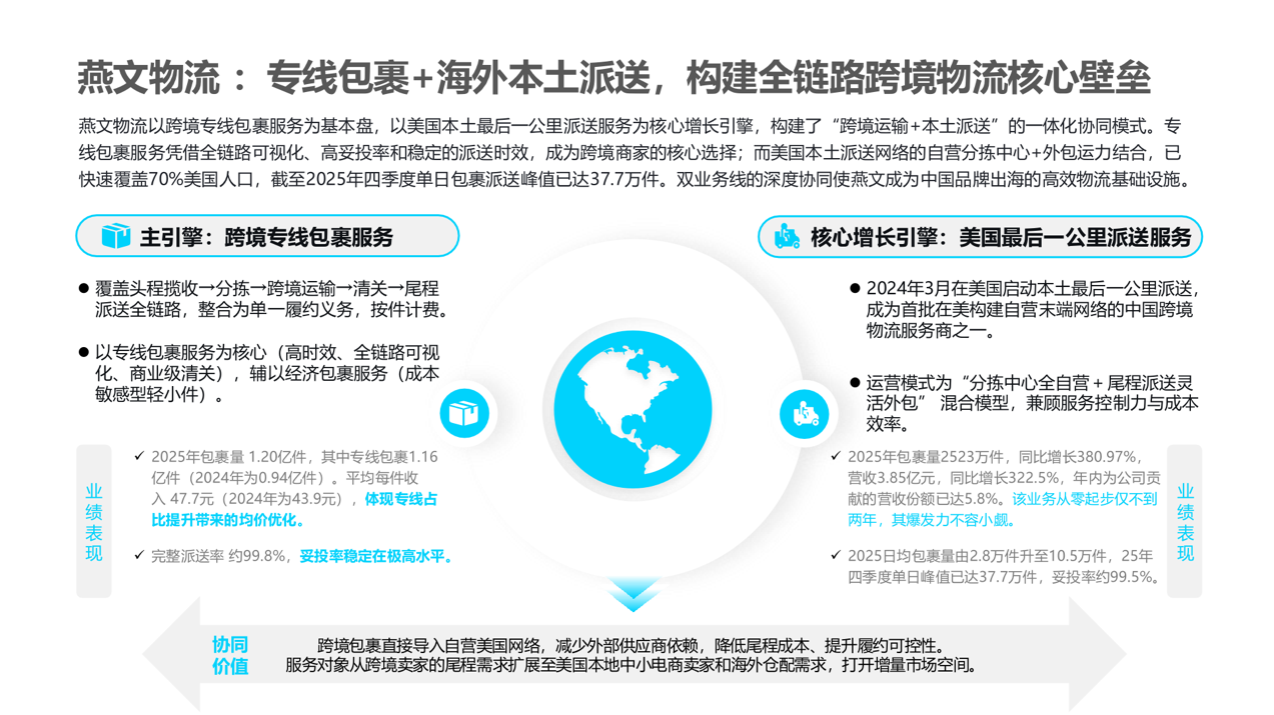
燕文物流作为直邮起家的老牌跨境电商物流服务商,在报告中呈现了“全球专线跨境直发运输+美国本土最后一公里派送”的双业务协同新模式。

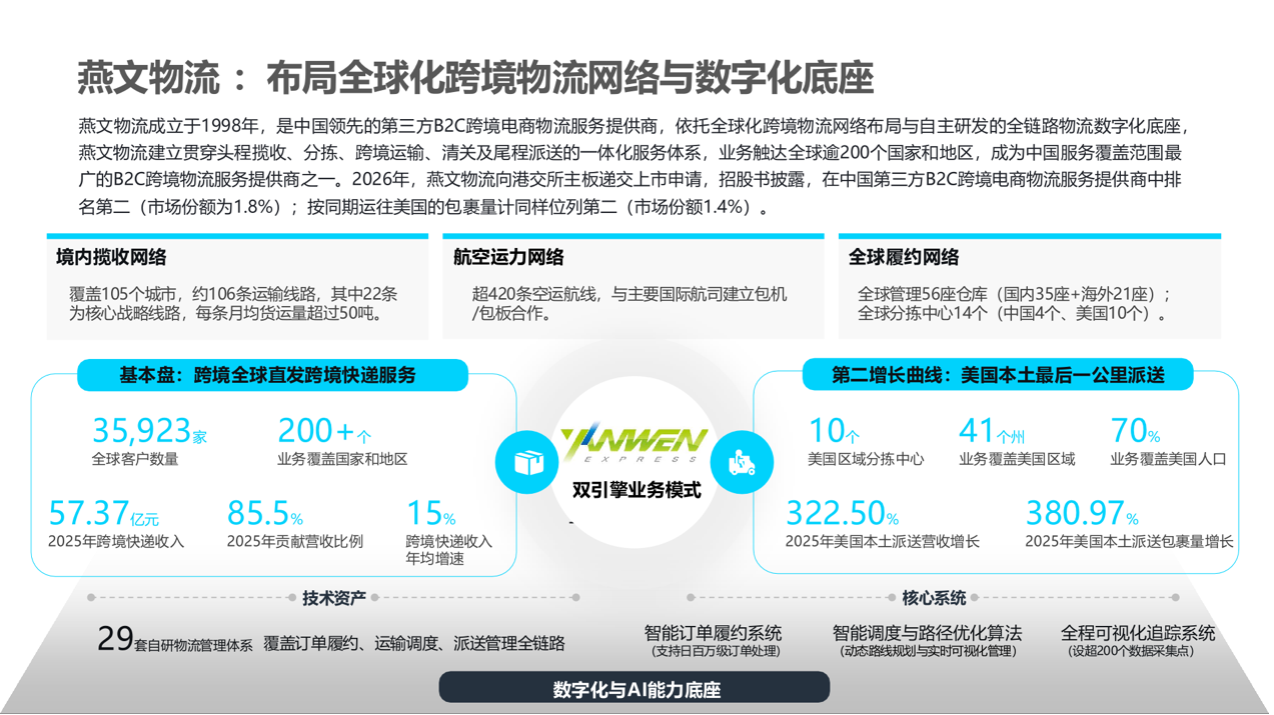
在跨境专线包裹服务方面,燕文物流业务覆盖全球200多个国家和地区,是少数具备广泛全球服务覆盖能力的中国物流企业之一。此外,燕文服务境内外超35923家B端客户,广泛覆盖跨境电商第三方平台、跨境商家及中国品牌出海企业。该服务围绕跨境商家的直发需求,连接境内揽收、分拣、跨境运输、清关和尾程派送,形成高时效、全链路可视化和商业级清关等能力。

在美国本土最后一公里派送方面,燕文物流相关业务已覆盖美国41个州,覆盖约70%美国人口。其运营模式采用“分拣中心全自营+尾程派送灵活外包”的混合模型,在服务控制力与成本效率之间找到了最优平衡。

燕文物流进入《2026全球化新品牌AI竞争力报告》跨境物流章节,也是品牌全球化进程中物流优化重要性的表现。

亿邦智库分析师认为,当前全球化新品牌竞争进入精细化阶段:成熟市场需要本地化交付体验、新兴市场需要低成本灵活测款;爆款要求稳定时效履约、长尾单品严控库存风险,品牌同时兼顾成本、时效、物流可视化、末端售后多重诉求。跨境物流服务商作为关键生态伙伴,能否提供适配效率、尾程体验和数智化协同能力,将直接影响品牌全球化经营竞争力。

文章来源:亿邦动力

广告
微信
朋友圈

FAQ回顾

跨境物流的跨境直达模式适合哪些应用场景?

跨境直达更适合新品测款、长尾小件、季节性快反商品和新兴市场冷启动场景,该模式具备不可替代的独特价值,未来有望占跨境物流30%的常态份额,可与海外仓模式互补覆盖品牌出海差异化物流需求。

燕文物流的跨境物流服务覆盖能力如何?

燕文物流跨境专线包裹服务覆盖全球200多个国家和地区,服务境内外超35923家B端客户;其美国本土最后一公里派送业务已覆盖美国41个州,覆盖约70%的美国人口,是少数具备广泛全球服务覆盖能力的中国物流企业之一。

品牌出海需要具备怎样的跨境供应链能力?

品牌出海不能仅依赖单一履约模式,需能按品类、市场、经营周期及成本多元适配海外仓、跨境直达等履约方式,兼顾成本、时效、物流可视化、末端售后多重诉求,才能有效提升全球化经营竞争力。

这么好看,分享一下?

朋友圈 分享

APP内打开

+1
+1
微信好友 朋友圈 新浪微博 QQ空间
关闭
收藏成功
发送
/140 0