广告
加载中

覆盖9000万月活用户:平安智享家医以“AI+真人”双引擎构建国民主动健康服务新范式

龚作仁 2026-06-16 17:20
龚作仁 2026/06/16 17:20

邦小白快读

EN
全文速览

这是平安好医生推出的AI+真人双引擎驱动的国民主动健康服务,目前已经接入平安集团全矩阵生态APP,无需单独下载应用就能使用,可触达9000万月活用户,能满足日常多场景健康需求。

1. 核心服务优势:提供7×24小时秒级响应的日常健康咨询,可完成症状初筛、健康评估、方案定制等服务,所有AI输出内容都有持证执业医师审核,疑难病症会自动转接人工专科医师一对一问诊,兼顾效率和安全。

2. 分层服务覆盖多元需求:覆盖亚健康人群预防管理、慢病人群精细化管控、刚性就医的分诊预约陪诊、应急药品1小时配送,还针对特殊群体提供定制化上门服务,可提供千人千面的个性化健康管理方案。

本文介绍了平安智享家医的创新发展路径,能给健康医疗领域品牌的发展提供多维度参考。

1. 消费趋势变化:当前国民健康需求已经从传统疾病治疗转向主动预防、持续管理、全域保障的全周期需求,用户需要多层次、个性化的家庭健康服务,传统服务模式已经无法满足需求。

2. 渠道建设参考:可以依托集团生态优势,将服务嵌入用户理财、出行、生活等高频日常场景,无需单独开发独立应用获客,就能触达海量月活用户,实现规模化普惠覆盖,大幅降低获客和推广成本。

3. 产品研发方向:采用AI大模型加真人复核的双引擎模式,针对不同人群分层开发服务,走千人千面的个性化路线,同时严守医疗质量安全底线,能有效解决行业痛点,建立品牌口碑。

平安智享家医的升级迭代,给健康医疗领域相关从业者明确了新的市场机会和发展方向。

1. 市场机会判断:当前国家推进健康中国2030战略落地,国民健康需求升级,主动健康管理属于增长型赛道,市场存在大量未被满足的需求,发展空间广阔。

2. 可学习的商业模式:采用生态嵌入模式,依托现有生态流量获取用户,降低独立获客成本,用AI承接高频需求提升效率,真人医生做专业兜底平衡安全,这套模式已经得到验证可复制。

3. 机会与风险提示:可以对接线下医疗、医药资源,针对慢病、老年、母婴等细分群体开发定制化服务,挖掘新增需求;同时需要注意严守医疗质量管控,建立专业复核机制,规避医疗安全风险。

本文披露了健康消费端的需求变化,给大健康相关生产制造工厂带来数字化转型和业务拓展的启示。

1. 产品生产设计方向:当前健康需求已经转向主动预防、个性化全周期管理,慢病患者、老年群体、母婴群体等都有细分的健康产品需求,工厂可针对亚健康调理、慢病养护、居家康养、产后护理等不同场景,开发适配细分需求的差异化产品,避开同质化竞争。

2. 数字化转型启示:AI大数据已经可以实现用户健康画像和精准需求研判,工厂可推进数字化改造,对接平台用户数据,优化产品研发方向,精准匹配用户需求。

3. 商业机会:可以对接平安这类大生态平台,接入平台服务网络,获得稳定流量和曝光,拓展产品销售渠道,触达更广泛的用户群体。

本文梳理了互联网医疗健康行业的发展趋势、核心痛点和成熟解决方案,对健康服务类服务商有较高参考价值。

1. 行业发展趋势:当前数字化、普惠化、场景化是互联网医疗产业高质量发展的核心方向,主动健康管理已经成为行业主流赛道,发展潜力巨大。

2. 行业核心客户痛点:目前行业普遍存在医疗资源分布不均、线下就医流程繁琐,传统线上医疗存在功能单一、智能化不足、缺乏专业复核、场景覆盖有限等问题,无法满足用户多层次个性化需求。

3. 可落地的解决方案:参考AI大模型加真人医师的双引擎模式,AI承接高频咨询提升效率,真人全流程复核保障安全,接入全域生态场景实现普惠覆盖,整合线上线下资源打造闭环服务,针对不同人群提供定制化服务,满足用户全周期健康需求。

平安智享家医的运营实践,给健康医疗类平台的运营管理和风险规避提供了可参考的样本。

1. 用户对平台的核心需求:用户希望获得全场景触达、专业化、个性化的全周期健康服务,不需要额外下载多个应用,更倾向于在日常高频场景中一键获取医疗服务。

2. 可借鉴的平台运营做法:依托集团多业态生态,将服务嵌入保险、银行、车主服务等高频流量端口,无需独立获客就能实现规模化用户覆盖;建立AI+真人的全流程质控体系,严守医疗安全底线,平衡效率和专业性;整合线下医疗医药资源,搭建覆盖预防、管理、就医、购药的全链条闭环服务,提升用户体验。

3. 风险规避要点:必须建立专业医疗兜底机制,不能过度依赖AI,要严守医疗质量安全红线,同时要避免同质化服务,打造个性化服务体系提升用户粘性。

本文介绍了互联网医疗领域的最新产业动向,提出了新型服务范式,对产业研究有较高的资料价值。

1. 产业新动向:当前国民健康需求发生结构性升级,从传统疾病治疗转向主动预防、全周期健康管理,数字化、普惠化、场景化已经成为互联网医疗高质量发展的核心方向,AI大模型开始深度应用于临床辅助健康服务领域,推动行业提质增效。

2. 创新商业模式:平安智享家医创造了AI秒级响应加真人医生全程监督的双引擎服务模式,依托平安集团全生态矩阵实现全域场景嵌入,无需独立APP获客就能触达海量用户,整合四到医疗资源形成闭环健康管理,实现了优质家庭医生服务的规模化、常态化、普惠化落地,构建了可广泛复制的数字化家庭健康服务新范式。

3. 产业现存问题:传统线下医疗存在资源分布不均、就医流程繁琐等问题,传统线上医疗存在功能单一、智能化不足、缺乏专业复核等短板,行业仍有待进一步创新升级解决这些问题。

返回默认
声明:快读内容全程由AI生成,请注意甄别信息。如您发现问题,请发送邮件至 run@ebrun.com 。

我是 品牌商 卖家 工厂 服务商 平台商 研究者 帮我再读一遍。

Quick Summary

This is a national proactive health service launched by Ping An Good Doctor, powered by a dual engine of AI and human professionals. It has been integrated into all ecosystem apps across Ping An Group, so users can access it directly without downloading a separate app, reaching 90 million monthly active users and meeting daily health needs across multiple scenarios.

1. Core competitive advantages: It provides 7/24 second-level response for daily health consultation, covering services such as initial symptom screening, health assessment and customized health plans. All AI-generated outputs are reviewed by licensed practicing physicians, and difficult or complex cases are automatically transferred to one-on-one consultations with specialist physicians, striking a good balance between efficiency and safety.

2. Tiered services cover diverse needs: It caters to preventive management for sub-health populations, refined control for people with chronic diseases, triage, appointment and accompaniment for in-person care, and one-hour emergency medicine delivery. It also offers customized in-home services for special groups, and can deliver personalized health management plans tailored to each individual user.

This article outlines the innovative development path of Ping An Smart Home Doctor, offering multi-dimensional references for brands in the health and medical industry.

1. Shifting consumer trends: Chinese consumers' health demands have shifted from traditional disease treatment to full-cycle needs including proactive prevention, continuous management and all-around coverage. Users now demand multi-layered, personalized family health services, which traditional service models can no longer meet.

2. Insights for channel development: Brands can leverage group ecosystem advantages to embed their services into high-frequency daily scenarios such as wealth management, travel and daily life, eliminating the need to develop a standalone app for customer acquisition. This allows brands to reach a massive monthly active user base, achieve large-scale inclusive coverage, and significantly cut customer acquisition and marketing costs.

3. Product development direction: Adopting a dual-engine model of large AI models with human review, developing tiered services for different population groups to deliver personalized, user-specific solutions, while strictly upholding medical quality and safety standards, can effectively solve common industry pain points and build strong brand reputation.

The upgrade of Ping An Smart Home Doctor has clarified new market opportunities and development directions for industry practitioners in the health and medical sector.

1. Market opportunity assessment: Against the backdrop of China's national implementation of the Healthy China 2030 strategy, Chinese consumers' health demands are upgrading, and proactive health management is a high-growth track with massive unmet needs and broad room for development.

2. Replicable business model to learn from: The ecosystem embedding model acquires users through existing ecosystem traffic to cut standalone customer acquisition costs, uses AI to handle high-frequency demands and improve efficiency, and leverages human physicians as a professional safety backstop. This model has been validated and is ready for replication.

3. Opportunity and risk notes: Sellers can connect with offline medical and pharmaceutical resources, develop customized services for niche groups such as chronic disease patients, seniors and mothers and babies to tap into new demand; at the same time, they must strictly enforce medical quality control and establish a professional review mechanism to avoid medical safety risks.

This article reveals shifting demand on the health consumer side, offering insights for digital transformation and business expansion for manufacturing factories in the big health sector.

1. Product design and development direction: Health demand has shifted to proactive prevention and personalized full-cycle management, and niche groups including chronic disease patients, seniors, and mothers and babies all have segmented demand for health products. Factories can develop differentiated products tailored to specific needs for different scenarios such as sub-health conditioning, chronic disease care, home-based wellness and postnatal care, to avoid homogeneous competition.

2. Insights for digital transformation: AI-powered big data can already generate user health profiles and identify precise demand. Factories can advance digital transformation, connect with platform user data, optimize product R&D direction, and match user demand more accurately.

3. New business opportunities: Factories can partner with large ecosystem platforms like Ping An, join their platform service network to gain stable traffic and exposure, expand product sales channels, and reach a broader user base.

This article sorts out development trends, core pain points and mature solutions for the internet healthcare industry, offering high reference value for health service providers.

1. Industry development trends: Digitalization, inclusiveness and scenario-based embedding are the core directions for high-quality development of the internet healthcare industry, and proactive health management has become a mainstream industry track with enormous development potential.

2. Core customer pain points: The industry generally suffers from uneven distribution of medical resources and cumbersome in-person care processes, while traditional online healthcare services face problems such as limited functions, insufficient intelligence, lack of professional review and narrow scenario coverage, making them unable to meet users' multi-layered personalized demands.

3. Actionable solutions: Service providers can adopt the dual-engine model of large AI models plus human physicians: AI handles high-frequency consultations to improve efficiency, while human physicians conduct full-process review to guarantee safety. Connecting to full ecosystem scenarios enables inclusive coverage, integrating online and offline resources builds closed-loop services, and offering customized services for different groups meets users' full-cycle health needs.

The operating practice of Ping An Smart Home Doctor provides a reference sample for operation management and risk mitigation for healthcare platforms.

1. Users' core demands for platforms: Users want full-scenario accessible, professional, personalized full-cycle health services, and prefer to access medical services with one click in their daily high-frequency scenarios instead of downloading multiple separate apps.

2. Replicable operational practices for platforms: Leveraging a group's multi-business ecosystem to embed services into high-frequency traffic portals such as insurance, banking and car owner services enables large-scale user coverage without independent customer acquisition; building a full-process quality control system combining AI and human professionals strictly upholds medical safety standards and balances efficiency and professionalism; integrating offline medical and pharmaceutical resources to build a full closed-loop service covering prevention, management, medical consultation and medication improves user experience.

3. Key points for risk mitigation: Platforms must establish a professional medical backstop mechanism, avoid over-reliance on AI, strictly adhere to medical quality and safety red lines, avoid homogeneous services, and build a personalized service system to improve user stickiness.

This article introduces the latest industrial trends in the internet healthcare sector and proposes a new service paradigm, offering high reference value as source material for industrial research.

1. New industrial trends: Chinese consumers' health demands are undergoing structural upgrading, shifting from traditional disease treatment to proactive prevention and full-cycle health management. Digitalization, inclusiveness and scenario-based embedding have become the core directions for high-quality development of internet healthcare. Large AI models are now being deeply applied in clinical-assisted health services, driving industry-wide improvement in quality and efficiency.

2. Innovative business model: Ping An Smart Home Doctor has created a dual-engine service model featuring AI-powered second-level response with full supervision from human physicians. It leverages Ping An Group's full ecosystem matrix to embed services across all scenarios, reaching massive users without a standalone app for customer acquisition, and integrates offline and online medical resources to build a closed-loop health management system. It has achieved large-scale, normalized and inclusive delivery of high-quality family doctor services, and established a widely replicable new paradigm for digital family health services.

3. Existing industrial problems: Traditional offline healthcare suffers from uneven resource distribution and cumbersome care processes, while traditional online healthcare has weaknesses including limited functions, insufficient intelligence and lack of professional review. Further innovation and upgrading are required for the industry to solve these problems.

Disclaimer: The "Quick Summary" content is entirely generated by AI. Please exercise discretion when interpreting the information. For issues or corrections, please email run@ebrun.com .

I am a Brand Seller Factory Service Provider Marketplace Seller Researcher Read it again.

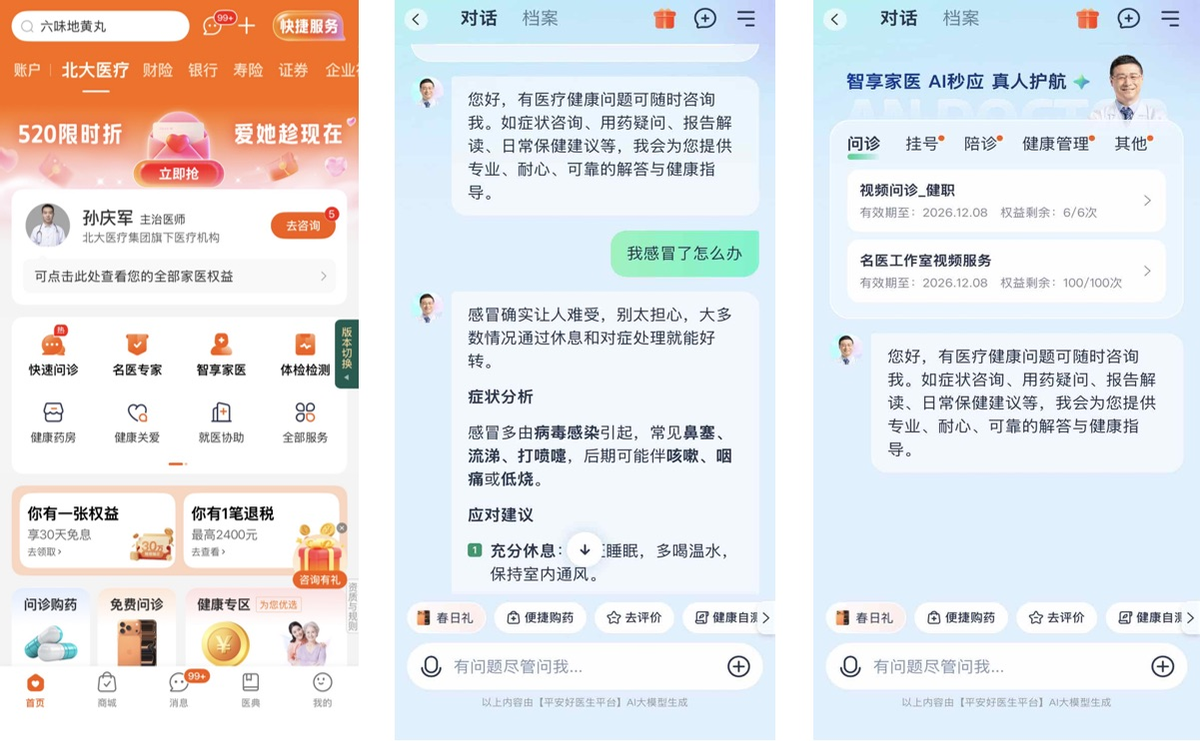
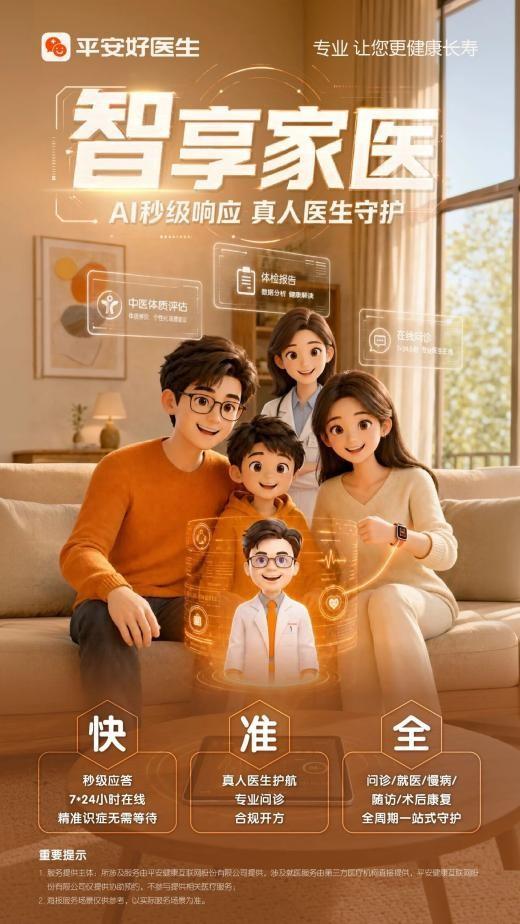
近日,平安好医生正式加码AI医生服务——平安智享家医,现已全面接入平安金管家、平安好车主、平安口袋银行、平安乐健康等平安集团全矩阵生态APP,服务可触达9000万月活用户。据悉,升级后的“智享家医”以平安医博通大模型为核心技术支撑,其构建“AI秒级响应+真人医生全程监督”为核心的服务模式,深度联动平台独有的“到线、到院、到家、到企”四到医疗健康服务网络。通过将智能化医疗能力与全域场景生态深度融合,平安智享家医有望实现优质家庭医生服务规模化、常态化、普惠化落地,为国民全生命周期健康管理提供数字化解决方案。

当前,国民健康需求已由传统“疾病治疗”向“主动预防、持续管理、全域保障”全面升级。但医疗资源区域分布不均、线下就医流程繁琐、基层家庭健康管理提升空间大、日常轻疾问诊渠道有限等问题仍长期存在。传统线上医疗服务普遍存在功能单一、智能化不足、缺乏专业复核、场景覆盖有限等短板,难以满足大众多层次、个性化、连续性的家庭健康需求。立足“健康中国2030”战略落地要求,平安好医生依托多年医疗科技积累与背靠平安集团生态优势,迭代升级平安智享家医服务,以技术创新补齐民生健康服务短板,构建可广泛复制的数字化家庭健康服务模式。

在技术架构层面,平安智享家医突破常规智能问答的功能局限,将AI大模型深度应用于临床辅助场景,可标准化完成症状初筛、病情研判、用药安全指导、健康风险评估、个性化方案定制等专业服务。系统支持7×24小时不间断值守、秒级智能响应,最快3秒即高效承接大众日常高频健康咨询需求,大幅缩短民众获取基础医疗服务的时间、降低使用门槛。为严守医疗质量与安全底线,平台建立全流程真人医师复核机制。所有AI输出的诊疗建议、健康指导方案均由持证执业医师审核校准;针对疑难病症、复杂慢病、潜在重症风险等场景,系统自动触发人工转接机制,由专科医师提供一对一深度问诊服务,实现“智能提速增效、专业医疗兜底”,平衡服务效率与医疗专业性、安全性。

依托平安集团多业态协同的生态优势,平安智享家医目前已实现全域场景渗透与规模化普惠覆盖。据了解,该服务无需独立下载单独APP或小程序应用,用户可在平安系保险、银行、证券、车主等各类高频生态端口一键直达,实现医疗服务与大众理财、出行、居家生活等日常场景无缝融合。依托9000万级月活生态底盘,服务覆盖全年龄、多圈层用户群体,有效推动优质医疗资源下沉,让标准化、高品质的家庭健康服务惠及更广民众。

在服务体系建设上,平安智享家医整合平安“到线、到院、到家、到企”全域医疗资源,可形成闭环式健康管理服务链条。针对健康及亚健康人群,平台提供标准化健康测评、电子健康档案动态管理、体检报告专业解读、常态化健康科普宣教等前置预防服务,帮助用户持续监测健康状态、提前规避健康风险,践行主动健康管理理念。针对高血压、糖尿病、高血脂等常见慢性病群体,推出专属慢病精细化管理服务,通过定期随访追踪、科学用药提醒、饮食运动专项指导、病情动态复盘,解决慢病患者管理不规范、随访不及时、养护不专业等痛点,实现慢病长期稳定管控。

此外,在刚性就医服务场景中,平安智享家医联动签约的三甲医院专家超3500名,逾5100家合作医院、24万家品牌连锁药店,可为用户提供精准分诊、专家预约、就医陪诊、住院协助等一站式便民就医服务,有效破解群众“看病难、就医繁、问诊盲”等民生问题。同时,依托全国多城即时配送网络,更能实现应急药品最快1小时送达,并提供常用药品平价保障,全面满足居民居家购药、应急用药、长期备药等刚需。针对老年群体、术后康复人群、母婴群体等特殊用户,平台配套专业化上门护理、居家康养、产后修复等定制化到家服务,补齐精细化家庭健康服务短板。

据平安智享家医负责人介绍,基于大数据算法与用户健康画像能力,智享家医摒弃同质化通用服务,推行 “千人千面” 个性化健康管理模式。结合用户年龄特征、身体指标、生活作息、既往病史及家庭健康情况,平台将精准匹配差异化健康养护方案,全面适配青年亚健康调理、职场健康防护、中老年慢病养护、儿童成长健康监护、全家综合健康保障等多元场景,打造适配中国家庭的标准化专属健康管家服务”。

行业观察人士指出,数字化、普惠化、场景化是互联网医疗产业高质量发展的核心方向,也是推进全民健康提质增效的重要路径。上述负责人表示,下一步,平安好医生将持续深耕医疗科技创新,迭代升级AI临床辅助能力,持扩容优质线下医疗资源与特色康养服务矩阵,丰富全场景健康服务内容,以科技赋能民生健康、以专业服务守护家庭安康,为健康中国数字化建设持续赋能。

注:文/龚作仁,文章来源:Laborer,本文为作者独立观点,不代表亿邦动力立场。

文章来源:Laborer

广告
微信
朋友圈

这么好看,分享一下?

朋友圈 分享

APP内打开

+1
+1
微信好友 朋友圈 新浪微博 QQ空间
关闭
收藏成功
发送
/140 0