广告
加载中

为什么其它品牌关店倒闭 泡泡玛特 瑞幸咖啡 胖东来4年业绩翻倍暴涨 我发现了这些增长

晏涛 2026-06-09 11:02
晏涛 2026/06/09 11:02

邦小白快读

EN
全文速览

本文分析了泡泡玛特、瑞幸咖啡、胖东来三家近年逆势业绩翻倍的零售品牌,总结了核心增长逻辑与可落地的实操干货,能给普通关注零售行业的读者带来清晰启发。

1. 核心结论:三家品牌分别代表了当下三种成熟的增长范式,泡泡玛特是全球IP商业化平台,瑞幸是数字化驱动的高频饮品零售网络,胖东来是高信任区域零售标杆,三者的增长核心都是靠构建强用户关系,而非单纯的渠道开店扩张。

2. 实操启发:做消费生意首先要回答“用户为什么反复回来”,对应不同路径可做差异化选择:做情绪收藏类产品走IP资产路线,做快消饮品走效率低价路线,做线下零售走信任服务路线;比起单个爆款,搭建支撑持续增长的系统能力更重要,不同定位都能实现增长,不用盲目跟风单一玩法。

本文通过三家头部逆势增长品牌的案例,梳理了当前消费行业的趋势与增长逻辑,给品牌商在营销、产品、渠道等多维度提供了参考。

1. 消费趋势判断:当前用户需求已经从单纯的产品使用价值,延伸到情绪价值、效率价值、信任价值,新需求催生了不同的增长路径,赛道之外运营模式决定增长结果。

2. 不同定位品牌的可借鉴玩法:做潮玩文创类品牌可转型IP资产组合运营,通过多IP孵化降低风险,延长IP生命周期,布局全球化多渠道,实现IP多次商业化;做饮品快消可走数字化规模化路线,通过高密度门店、高频上新摊薄成本,用运营效率支撑低价定位;做线下商超可通过高员工激励打造高服务信任,强化商品力建立区域口碑。

3. 核心提醒:品牌增长的核心是强化用户关系,靠持续创造用户价值实现增长,而非单纯依赖渠道扩张。

本文点明当前零售行业冰火两重天的现状,总结了三家头部增长品牌的经验、风险与可借鉴方向,能给各类零售卖家提供明确的增长参考。

1. 增长机会方向:当前IP情绪消费、低价高频饮品、区域高信任零售都是高速增长的赛道,不同规模、不同定位的卖家都能找到对应的切入点,不用一味挤热门赛道。

2. 可学习要点:中小区域卖家可优先学习胖东来的服务信任逻辑,深耕区域做好口碑,同样能实现三倍以上增长;中大型卖家可学习瑞幸的数字化闭环运营、高频产品创新思路,以及泡泡玛特的IP资产运营方法,放大增长规模。

3. 风险提示:做IP生意要警惕IP集中度高、爆款周期短的风险;做加盟扩张要注意加盟质量管控、配送成本上升压缩利润的风险;做区域零售不要盲目全国扩张,要警惕超出自身能力边界的复制风险。

本文通过三家零售品牌的增长案例,梳理了终端需求变化带来的生产端机会与转型启示,适合生产端工厂参考。

1. 产品生产与设计需求变化:当前用户对产品的需求已经从基础使用功能,延伸到情绪价值、品质信任,工厂在设计生产时,需要兼顾产品的情绪属性、品质透明度,同时要适配品牌方多SKU快速迭代的需求,比如瑞幸一年推出上百款新品,对供应链的快速响应能力要求远高于传统零售。

2. 新商业机会:IP商业化的发展,给工厂带来了更多IP周边产品的生产合作机会;胖东来等品牌的自有品牌发展,也给工厂代工打造合作产品线留出了增量空间;泡泡玛特的全球化扩张,也给国内供应链带来了海外市场的增量订单。

3. 数字化转型启示:工厂需要适配品牌方的数字化需求,提升生产响应效率,支撑高频上新、规模化柔性生产的要求,才能对接头部品牌的增长需求,分享行业增长红利。

本文梳理了当前零售行业的发展趋势、品牌端的核心痛点,给零售相关服务商指明了业务方向,有较高的参考价值。

1. 行业发展趋势:当前零售行业的竞争已经从渠道扩张竞争,转向用户关系运营的竞争,IP孵化运营、品牌数字化赋能、传统商超调改都成为新的增量服务市场,行业对专业服务的需求在快速增长。

2. 客户核心痛点:多数品牌面临无法持续拉动用户复购、单个爆款难以支撑长期增长、组织能力跟不上规模扩张速度的问题;大量传统线下商超普遍面临客流下滑、口碑下滑、不知道怎么转型的痛点。

3. 解决方案方向:服务商可以针对IP品牌开发IP孵化、全球化运营配套服务;针对零售品牌开发数字化运营、供应链配套服务;针对传统线下商超,可以输出胖东来模式的调改咨询服务,帮助品牌优化组织管理、提升服务体验,解决转型痛点。

本文通过三家零售品牌的增长案例,总结了品牌端对零售平台的核心需求,以及平台发展可参考的方向与风险规避要点。

1. 品牌对平台的核心需求:品牌需要平台能够支撑全渠道触达用户,同时帮助品牌沉淀用户数据,支撑品牌的数字化运营;IP类品牌还需要平台支持IP商业化落地,帮助其拓展全球市场;线下零售品牌需要平台帮助其打造区域口碑,获取本地用户信任。

2. 平台可借鉴的运营方向:平台可参考泡泡玛特线上线下共振的多渠道布局,搭建线上线下融合的零售网络,针对不同定位品牌匹配对应的流量、运营资源,为规模化扩张品牌提供数字化选址、供应链配套支持。

3. 风险规避要点:平台招商和运营中,要关注品牌IP集中度过高、加盟扩张质量参差不齐、盲目扩张导致的经营风险,提前做好风险防控,优先选择有系统能力、有用户信任基础的品牌合作。

本文梳理了2022-2025年中国消费零售行业的增长新动向,总结了三种代表性的增长商业模式,对产业研究有较高的参考价值。

1. 产业新动向:当前零售行业呈现明显的冰火两重天格局,传统零售品牌普遍增长乏力,主动适配新用户需求的品牌能实现逆势翻倍增长,行业增长逻辑已经从传统的渠道扩张转向用户资产运营,信任成为增长的核心“货币”。

2. 三种代表性新商业模式:分别是泡泡玛特的全球IP商业化平台模式,通过IP多轮商业化实现增长;瑞幸咖啡的数字化驱动高频饮品零售网络模式,靠规模效率支撑低价增长;胖东来的高信任区域零售模式,靠组织信任和服务体验实现增长,三种模式验证了不同定位都能实现可持续增长。

3. 研究启示:本文打破了低价等于低端、扩张必须全国化的固有认知,证明高情绪价值、高信任都能支撑合理毛利,组织能力才是增长的底层支撑,为零售产业研究提供了新的观察方向。

返回默认

声明:快读内容全程由AI生成,请注意甄别信息。如您发现问题,请发送邮件至 run@ebrun.com 。

我是 品牌商 卖家 工厂 服务商 平台商 研究者 帮我再读一遍。

Quick Summary

This article analyzes three retail brands—Pop Mart, Luckin Coffee, and Fat Donglai—that have achieved revenue doubling against the broader industry downturn in recent years. It summarizes their core growth logic and actionable takeaways, offering clear insights for readers following the retail industry.

1. Core conclusion: The three brands represent three mature growth paradigms dominating the current market: Pop Mart operates as a global IP commercialization platform, Luckin is a digital-driven high-frequency beverage retail network, and Fat Donglai is a high-trust regional retail benchmark. All three anchor their growth in building strong user relationships, rather than pure expansion via opening new stores.

2. Actionable insights: For any consumer business, the first question to answer is "why will customers come back repeatedly", and brands can choose differentiated paths based on their positioning. Emotional and collectible products should pursue an IP asset strategy, fast-moving beverages should focus on efficiency and low prices, and offline retail should prioritize trust and service. Compared to relying on a single hit product, building systemic capabilities to support sustained growth matters far more. Growth is achievable for any brand positioning, so there is no need to blindly follow one-size-fits-all popular tactics.

Drawing on case studies of three leading brands that achieved growth against the tide, this article maps current consumer industry trends and core growth logic, providing multidirectional reference for brands across marketing, product development, channel strategy and more.

1. Consumer trend assessment: Consumer demand has expanded beyond pure functional product value to now include emotional value, efficiency value and trust value. These new demands have spawned distinct growth paths, and operational model, rather than track selection, ultimately determines growth outcomes.

2. Actionable strategies for brands of different positioning:潮玩文创 brands can pivot to IP portfolio operation, lowering risk through multi-IP incubation, extending IP lifecycles, expanding global multi-channel distribution, and unlocking repeated IP commercialization. Fast-moving beverage brands can adopt a digital-driven scaling strategy, cutting unit costs via high-density store networks and frequent new product launches, and supporting a low-price positioning through operational efficiency. Offline retailers can build high service trust through strong employee incentives, and reinforce regional word-of-mouth via strong product capability.

3. Core reminder: The foundation of brand growth is strengthening user relationships, driving growth through sustained delivery of user value rather than relying solely on channel expansion.

This article addresses the stark divergence between winners and losers in today's retail industry, summarizes the experiences, risks, and actionable lessons from three high-growth leading brands, and offers clear growth guidance for retail sellers of all types.

1. Growth opportunity directions: IP-driven emotional consumption, low-price high-frequency beverages, and high-trust regional retail are all fast-growing tracks. Sellers of all sizes and positioning can find aligned entry points, rather than rushing to crowd into overheated popular tracks.

2. Key takeaways: Small and medium-sized regional sellers can prioritize adopting Fat Donglai's trust-through-service logic, focusing on deepening regional penetration and building word-of-mouth to deliver tripling or greater growth. Mid-to-large sellers can learn from Luckin's closed-loop digital operation and high-frequency product innovation, as well as Pop Mart's IP asset operation methodology, to scale growth.

3. Risk warnings: IP-focused businesses should guard against the risks of over-reliance on a small number of top IPs and short lifecycles for hit products. Brands pursuing franchise expansion must pay close attention to franchise quality control and the margin compression risk of rising distribution costs. Regional retailers should avoid blind nationwide expansion, and stay alert to the replication risk of exceeding organizational capability boundaries.

Based on the growth cases of the three retail brands, this article summarizes the production-side opportunities and transformation insights brought by shifting end consumer demand, making it a useful reference for manufacturing factories.

1. Shifts in product design and production requirements: Consumer demand has expanded beyond basic functional utility to now include emotional value and quality trust. Factories need to incorporate emotional product attributes and quality transparency into design and production, while also adapting to brand requirements for multi-SKU rapid iteration. For example, Luckin launches over 100 new products annually, which requires far faster supply chain response capabilities than traditional retail.

2. New business opportunities: The growth of IP commercialization has created more collaborative production opportunities for factories to make IP derivative products. The growth of private labels among brands like Fat Donglai has also opened up incremental space for factories to develop co-branded contract manufacturing lines. Pop Mart's global expansion has also brought incremental overseas order volume for Chinese supply chains.

3. Digital transformation insights: Factories need to align with the digital requirements of brand clients, improve production response efficiency, and support the demands of frequent new product launches and scaled flexible manufacturing. This allows them to serve the growth needs of leading brands and capture a share of the industry's growth dividend.

This article sorts out current retail industry development trends and the core pain points of brand clients, clarifies promising business directions for retail-related service providers, and offers high-value reference.

1. Industry development trends: Retail industry competition has shifted from channel expansion competition to competition in user relationship operation. IP incubation and operation, brand digital enablement, and traditional hypermarket renovation have all emerged as new incremental service markets, and industry demand for professional services is growing rapidly.

2. Core client pain points: Most brands struggle with consistently driving user repurchase, the inability of a single hit product to support long-term growth, and organizational capabilities that cannot keep pace with scaling. A large number of traditional offline hypermarkets face widespread pain points of declining foot traffic, fading reputation, and lack of clear direction for transformation.

3. Solution directions: Service providers can develop IP incubation and global operation supporting services for IP-focused brands; build digital operation and supply chain supporting services for general retail brands; and offer Fat Donglai-model transformation consulting services for traditional offline hypermarkets, helping brands optimize organizational management, improve service experience, and resolve transformation pain points.

Through the growth cases of the three retail brands, this article summarizes the core demands that brands have for retail platforms, as well as actionable development directions and risk mitigation guidance for platforms.

1. Core brand demands from platforms: Brands need platforms to support omni-channel user reach, while helping brands accumulate user data to support their digital operations. IP-focused brands additionally need platforms to support IP commercialization and help them expand into global markets. Offline retail brands need platforms to help them build regional reputation and win trust from local users.

2. Actionable operational directions for platforms: Platforms can learn from Pop Mart's omnichannel strategy of online-offline synergy, build an integrated online-offline retail network, allocate matching traffic and operational resources for brands of different positioning, and provide digital site selection and supply chain supporting services for scaling brands.

3. Risk mitigation guidance: During merchant recruitment and operation, platforms should pay close attention to operational risks caused by excessive IP concentration, inconsistent franchise quality from rapid expansion, and over-aggressive expansion. Platforms should implement proactive risk prevention, and prioritize partnerships with brands that have built systemic capabilities and solid user trust.

This article sorts out new growth dynamics in China's consumer retail industry from 2022 to 2025, summarizes three representative growth business models, and offers high reference value for industrial research.

1. New industry dynamics: The retail industry is currently marked by a stark divergence between underperformers and outperformers. Traditional retail brands generally face stagnant growth, while brands that actively adapt to new consumer demand have achieved doubling growth against the tide. The core industry growth logic has shifted from traditional channel expansion to user asset operation, and trust has become the core "currency" of growth.

2. Three representative new business models: These are Pop Mart's global IP commercialization platform model, which drives growth through multi-cycle IP monetization; Luckin Coffee's digital-driven high-frequency beverage retail network model, which supports low-price growth through scale and efficiency; and Fat Donglai's high-trust regional retail model, which delivers growth through organizational trust and service experience. All three models prove that sustainable growth is achievable for brands with any positioning.

3. Research implications: This article breaks through conventional assumptions that low prices equal low quality and expansion requires nationwide footprint. It proves that high emotional value and high trust can both support healthy gross margins, and organizational capability is the underlying foundation of growth. It offers a new perspective for retail industry research.

Disclaimer: The "Quick Summary" content is entirely generated by AI. Please exercise discretion when interpreting the information. For issues or corrections, please email run@ebrun.com .

I am a Brand Seller Factory Service Provider Marketplace Seller Researcher Read it again.

零售行业是冰火两重天, 一部分品牌接连关店,倒闭,营收利润纷纷下降;另一部分品牌,生意爆火,甚至年年三位数增长。比如像泡泡玛特,2020年上市营收才25亿左右,2025年破370亿。

这背后,既有行业赛道的差别,更有公司面对新消费、新需求变化所采取的经营,增长方式的变化非常相关。

泡泡玛特,瑞幸咖啡和胖东来是我常关注的3家零售企业,也是近4年逆势猛增的品牌。今天分享些我关于它们经营,营销,增长方面的总结思考。相信对你会有启发。

一、先说总结判断

泡泡玛特卖的是IP的稀缺性与情绪价值,瑞幸卖的是标准化饮品的高频履约效率,胖东来卖的是零售现场的信任感和服务体验。

4年时间,它们最高业绩有涨8倍,都是几十亿级别增长。不能简单说,它们是幸运的,偶然的,个例的。

反而,我一直认为,这三家公司代表了2022-2025年中国消费企业的三种增长范式:

泡泡玛特:从“潮玩零售公司”升级为“全球IP商业化平台”。2022年收入46.17亿元,2025年收入371.20亿元,三年复合增长极高;2025年 THE MONSTERS/LABUBU成为核心增长引擎,但IP集中度也上升。

瑞幸咖啡:从财务造假后的修复期进入规模化进攻期。2022年净收入132.93亿元,2025年净收入492.88亿元;门店数从8,214家增至31,048家,核心能力是数字化选址、供应链、加盟与高频产品上新。

胖东来:不是全国扩张型连锁,而是“高组织信任、高员工福利、高商品力、高服务体验”的区域零售标杆。2022年销售额约70亿元,2025年公开披露销售额235.31亿元;其价值不在规模复制,而在为传统商超提供“调改方法论”。

二、核心数据对比

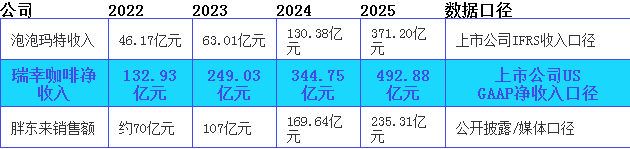
增长太猛了,泡泡玛特翻了8倍,相比2020年上市的营收涨了15倍;瑞幸涨了快4倍,胖东来3倍多。

从几十亿到几百亿量级连续增长。即使泼天富贵能接住几年,这家公司的经营地盘也是要稳得住的。

当公司营收翻倍增长,一定意味着团队急速扩张。我经历过团队从30多人一下子暴增几百人的情况,大部分会很快陷入混乱,最后面临极大危机,甚至倒闭。所以可以先想想这三家公司不仅接住增长,还能稳健经营,足见基本盘的扎实。

公司 2022 2023 2024 2025 数据口径
泡泡玛特收入 46.17亿元 63.01亿元 130.38亿元 371.20亿元 上市公司IFRS收入口径
瑞幸咖啡净收入 132.93亿元 249.03亿元 344.75亿元 492.88亿元 上市公司US GAAP净收入口径
胖东来销售额 约70亿元 107亿元 169.64亿元 235.31亿元 公开披露/媒体口径

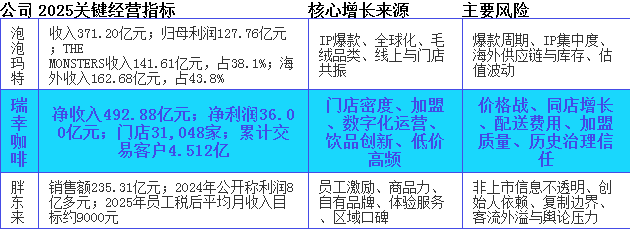
公司 2025关键经营指标 核心增长来源 主要风险
泡泡玛特 收入371.20亿元;归母利润127.76亿元;THE MONSTERS收入141.61亿元,占38.1%;海外收入162.68亿元,占43.8% IP爆款、全球化、毛绒品类、线上与门店共振 爆款周期、IP集中度、海外供应链与库存、估值波动
瑞幸咖啡 净收入492.88亿元;净利润36.00亿元;门店31,048家;累计交易客户4.512亿 门店密度、加盟、数字化运营、饮品创新、低价高频 价格战、同店增长、配送费用、加盟质量、历史治理信任
胖东来 销售额235.31亿元;2024年公开称利润8 亿多元;2025年员工税后平均月收入目标约9000元 员工激励、商品力、自有品牌、体验服务、区域口碑 非上市信息不透明、创始人依赖、复制边界、客流外溢与舆论压力

三、关于泡泡玛特启示

1. 阶段判断

2022年泡泡玛特处在上市后调整期,收入为46.17亿元,归母利润4.76亿元,增长受到疫情、线上流量效率变化和消费环境影响。2023年开始恢复,收入升至63.01亿元,港澳台及海外收入达到10.66亿元,占收入16.9%。

2024年是业务质变的开始,收入130.38亿元,同比增长106.9%,归母利润31.25亿元,海外业务和THE MONSTERS同时放量。2025年则进入全球爆发期,收入371.20亿元,同比增长184.7%,归母利润127.76亿元,同比增长308.8%。

这里能看到,泡泡玛特的核心变化不是单纯卖更多盲盒,而是从“产品零售”转向“IP资产组合运营”:同一个IP可以通过手办、毛绒、MEGA、饰品、主题展、乐园、快闪与海外门店多次商业化。

2. 核心能力

从我对泡泡玛特的观察研究,它有4层非常强的核心能力:

IP发现与孵化:通过签约艺术家、自有设计、授权合作形成IP池,降低单一IP早期不确定性。

产品化能力:把抽象角色变成盲盒、毛绒、饰品、MEGA、主题店与展览,延长IP生命周期。(其实这也是延长用户全生命周期非常重要的方法)

渠道控制:国内门店、机器人商店、小程序抽盒机、天猫、抖音与海外APP/官网共同形成高触达网络。

全球化运营:2025年中国区以外收入已接近总收入一半,证明其不是纯中国消费故事,而是全球情 绪消费故事。

4. 借鉴方法

对消费企业而言,泡泡玛特最值得学习的不是盲盒,而是“把产品做成可持续运营的情绪资产”。

建立多IP组合,而不是押注单一产品;让渠道成为用户社区与新品发布场,你看它的每个实体店设计就是艺术品;让商品从“使用价值”升级为“身份表达、社交谈资、收藏欲望”。

可能有人觉得我不卖盲盒,不做IP产品,没必要。这就错了,王宁讲,消费的本质是,满足感和存在感。这是非常透彻的洞察。

四、关于瑞幸咖啡启示

1. 阶段判断

瑞幸2022年已经走出财务造假后的重组期,全年净收入132.93亿元,同比增长66.9%,门店8,214家,GAAP经营利润11.56亿元。

2023年进入高速扩张,净收入249.03亿元,同比增长87.3%,门店16,248家。2024年净收入344.75亿元,同比增长38.4%,门店22,340家,但同店增长受到价格战影响。

2025年净收入492.88亿元,同比增长43.0%,门店增至31,048家,净利润36.00亿元。

瑞幸的本质是“数字化驱动的高频饮品零售网络”,不是传统咖啡馆。它把咖啡店拆解成选址、菜单、供应链、订单系统、履约与营销算法,通过门店密度和高频上新来压缩单位成本。

2. 财务与经营结构

2025年瑞幸净收入492.88亿元,其中产品销售收入376.94亿元,占76.5%;加盟店收入115.94亿元,占23.5%。鲜萃饮品收入346.17亿元,占70.2%,仍是绝对核心。2025年经营利润50.73亿元,经营利润率10.3%;净利润36.00亿元,净利率7.3%。

2025年门店净增8,708家,年末总门店31,048家。其中自营门店20,234家,联营门店10,814家。累计交易客户4.512亿,2025年售出商品约44亿件。规模已经成为瑞幸最重要的防御壁垒:规模越大,采购、广告、系统、研发、选址模型和供应链固定成本越容易摊薄。

但成本侧压力也明显。2025年配送费用从2024年的28.21亿元升至68.79亿元,占收入比从8.0% 升至13.9%,主要来自第三方外卖平台订单增加。这说明外卖增长虽然扩大交易量,但会压缩门店层面和公司层面的利润弹性。

3. 核心能力

瑞幸算是一个奇迹的公司,它的核心能力包括:

数字化闭环:用户从下单、优惠券、复购、上新反馈到门店排产都沉淀在系统中。

规模化产品创新:生椰拿铁、酱香拿铁等产品证明瑞幸擅长把爆款饮品工业化、全国化。

自营与联营组合:自营保证核心城市密度和运营标准,联营帮助下沉市场扩张。

供应链前置:自建烘焙工厂、原料采购和门店标准化使其可以在低客单价下维持经营利润。

价格战承受力:瑞幸不是不受价格战影响,而是比多数竞争者更能承受价格战。

4. 可借鉴方法

瑞幸真是不折不扣的极致效率,产品创新的玩法。他一年能上新110多款产品,当年星巴克才一年43款,你就能看到多卷,。关键是你要上新100多款,这背后尝试的可能有几百款,一般公司产品研发投入,效率能跟得上吗,传统很难。

瑞幸最值得学习的是“高频消费品的系统化经营”:不要只看单店,而要看全国门店网络、用户数据、产品上新和供应链之间的闭环。它证明在中国消费市场,低价不一定等于低端;如果效率足够高,低价也可以成为规模壁垒。(拼多多也是典型案例)

五、关于胖东来启示

1. 阶段判断

胖东来是三家公司里最特殊的一家。它不是上市公司,也不是全国扩张型连锁,而是深耕河南许昌、新乡的区域零售企业。甚至于东来一直说,胖东来不是企业,它是一所学校。

公开资料显示,胖东来2022年销售额约70亿元,2023年销售额107亿元,2024年销售额169.64亿元,2025年销售额235.31亿元。

2024-2025年,胖东来从区域零售品牌变成全国零售行业“方法论样板”。它本身没有大规模开店,但通过帮扶步步高、永辉等企业调改,把商品、服务、员工待遇、自有品牌和现场管理方式外溢到行业。

2024年,于东来说集团整体销售近170亿元、税收6 亿多元、利润8 亿多元、员工平均月收入9000多元。按零售行业常识,这一利润水平并非暴利,但它把利润分配、员工体验和顾客体验绑定在一起,形成了强口碑。

2. 核心能力

我去过胖东来,亲自体验了他们的现场和服务。进去之前我告诉自己不买东西,逛完之后忍不住买了很多东西。这说明什么,消费从来没有什么真正的理性,当体验和服务打动你的时候,就忍不住消费了。

胖东来并不主动要求,强迫,诱导任何人消费。但是它有让你消费的魅力。

胖东来的核心能力不是某一个SKU,也不是某一种服务话术,而是组织和文化的信任。它的优势主要有五个:

员工激励:较高薪酬、较短工时、较长休假,让一线员工有服务意愿,而不是被动执行。(员工积极性是最好的营销)

商品力:强调品质、透明、可退换、敢于承担售后责任,降低顾客决策成本。

现场秩序:卖场动线、陈列、卫生、服务响应、客诉处理形成稳定体验。

自有品牌:DL系列商品不仅在胖东来内部销售,也在帮扶调改中被其他商超引入。

价值观表达:胖东来的“善待员工、善待顾客”不是营销口号,而是被顾客在现场感受到的经营制度。

3. 可借鉴方法

这几年商超百货一片颓废,也让胖东来成为舆论风口,都要去学。当然物极必反,有人公开抵制,比如最近有个连锁品牌超市就打出,我们做不到自由与爱。像这种声音都是异化了胖东来。

胖东来最值得学习的是“把员工体验当作顾客体验的前置条件”。这个观念很赞。很多企业只研究服务动作,忽略服务意愿。

胖东来的逻辑是:员工被尊重,才更可能尊重顾客;商品有底线,服务才有底气;利润不是最大化,而是维持组织长期健康。

我最近再看西蒙斯涅克写的《无限游戏》这本书,美团王兴很早推荐多这本书,商业为什么非得是零和博弈,你是我活呢?为什么非得时刻都是利益最大化?能不能是持续下去呢,我觉得也是可以的。

企业跟顾客并不是对立面,你要多赚,我要少花,可不可以是相互更持久,更健康的某种关系保持,换一个视角,经营理念就会发生变化。

六、它们的共同点和其它思考

这三家公司从2022-2025年翻倍增长。还说明一个道理,消费企业的增长不光只靠渠道扩张(开更多店),而要靠“更强的用户关系”(买的更多/推荐买)。

泡泡玛特用IP建立关系,瑞幸用App与高频交易建立关系,胖东来用信任和服务建立关系。

从经营上讲,这种关系就是我说的用户资产。关系越强,LTV相应会越高。

每个企业都有自己独特地方,但核心是围绕用户的信任关系,关系怎么来?通过创造持续用户价值。用户价值包括在哪些地方?产品,体验,服务,品牌,售后等等。

最终,所有的成交那一刻,都是信任关系货币化,信任的兑现。

其它启发

1)要可持续增长,消费企业必须回答“用户为什么反复回来”。泡泡玛特的答案是情绪与收藏,瑞幸的答案是便利与性价比,胖东来的答案是信任与安心。

2)爆款重要,但系统更重要。泡泡玛特需要具备打造多IP的能力,瑞幸需要用供应链承接新品,胖东来需要用制度承接服务口碑。

3)低价不是唯一出路。瑞幸证明效率可以支撑低价;胖东来证明高信任也能支撑客流;泡泡玛特证明高情绪价值可以支撑高毛利。

4)组织能力最终会体现在财务上。员工、供应商、门店、用户不是成本项,而是增长系统的一部分。

/完

注:文/晏涛,文章来源:晏涛营销笔记(公众号ID:yantao-219),本文为作者独立观点,不代表亿邦动力立场。

文章来源:晏涛营销笔记

广告
微信
朋友圈

FAQ回顾

泡泡玛特在2022至2025年间的核心增长模式是什么?

泡泡玛特的核心增长模式是从潮玩零售公司升级为全球IP商业化平台。其收入从2022年的46.17亿元增长至2025年的371.20亿元,核心驱动力包括IP爆款(如THE MONSTERS)、全球化扩张(2025年海外收入占比43.8%)以及通过多渠道(门店、线上)运营IP资产组合。

瑞幸咖啡在2025年的关键经营数据和增长策略是什么?

瑞幸咖啡2025年净收入达492.88亿元,门店总数31,048家,净利润36.00亿元。其增长策略基于数字化驱动的高频饮品零售网络,核心能力包括数字化选址与运营、规模化产品创新(如生椰拿铁)、自营与加盟结合的模式,以及通过供应链效率支撑低价高频消费。

胖东来作为区域零售标杆,其核心能力和增长逻辑是什么?

胖东来以高组织信任、高员工福利和高服务体验为核心能力。其销售额从2022年的约70亿元增长至2025年的235.31亿元。增长逻辑在于将员工体验作为顾客体验的前置条件,通过高薪酬、商品力(如自有品牌)和卓越的现场服务建立区域口碑与顾客信任。

这么好看,分享一下?

朋友圈 分享

APP内打开

赞 +1
+1
微信好友 朋友圈 新浪微博 QQ空间
关闭
收藏成功
发送
/140 0