广告
加载中

2026中国AI应用全景图谱发布

龚作仁 2026-05-20 15:20
龚作仁 2026/05/20 15:20

邦小白快读

EN
全文速览

本文核心信息是2026年AI应用已经完成从聊天回答到实际做事的范式转变,中国已经形成完整AI产业生态,核心干货如下:

1. 核心数据:2026年4月国内AI应用Web端月访问量突破9亿,APP端月下载量超2.4亿,日活同比暴涨223%,全国日均Token调用量突破140万亿,两年增长超千倍,中国是全球AI应用活跃度最高的国家。

2. 赛道表现:AI效率办公Web端用户活跃份额超七成,AI创作APP端日活年增449%,智能助手用户留存最高,AI文娱黏性两极分化,能嵌入日常工作流的AI才会被用户长期留存。

3. 商业化进展:多个头部AI产品已经跑通付费模式,用户愿意为能解决实际问题的AI主动付费,AI行业已经从尝鲜阶段进入实用阶段。

本文披露了2026年中国AI应用行业的最新发展态势,能为品牌商布局AI、把握消费趋势提供参考,核心干货如下:

1. 消费趋势变化:用户对AI的需求已经从尝鲜娱乐转向实用解决问题,只有嵌入日常工作生活流程的AI才能留住用户,当前AI效率办公、AI创作赛道增长表现最亮眼,是值得布局的方向。

2. 营销竞争启示:字节、阿里、腾讯、百度四家巨头合计砸45亿争夺AI入口,本质是抢用户的默认使用习惯,谁拿下用户习惯谁就能掌握未来十年的主动权,品牌布局AI需要重视用户使用习惯的培养。

3. 商业化提示:当前AI付费逻辑已经跑通,只要产品能真正解决用户问题,用户会自然付费,品牌不用过度说服用户付费,核心要做深自身品牌对应的垂直场景。

本文梳理了2026年AI应用行业的最新变化,能为有意布局AI赛道的卖家提供机会、风险参考,核心干货如下:

1. 当前入场机会:AI模型技术普惠化,成本大幅下降,DeepSeek V4-Pro API价格仅为GPT-5.5的七分之一,技术门槛降低,中小卖家也有入场空间,AI从回答转向执行的范式转变带来了大量新的市场机会。

2. 高增长赛道提示:AI效率办公、AI创作是当前C端增速最快的赛道,B端的医疗、金融、法律是垂直场景中渗透最快的高价值战场,早入场更容易积累用户和数据,建立竞争壁垒。

3. 风险提示:当前头部巨头砸钱抢用户入口,用户留存分化严重,仅靠娱乐属性无法留住用户,必须把AI嵌入日常工作流才能留客,进场晚的玩家很难突破头部玩家在垂直场景的护城河。

本文总结了2026年AI应用行业的五大发展趋势,能为工厂推进数字化转型、挖掘商业机会提供参考,核心干货如下:

1. 转型基础成熟:当前国内已经形成完整的AI产业价值传导链,覆盖底层开发、ToB应用等全环节,工厂推进数字化转型有了成熟的技术生态可以依托,不用从零搭建。

2. 数字化落地成本降低:AI模型已经实现普惠化,能力提升同时价格大幅下降,AI已经可以完成主动规划、执行多步骤任务,工厂可以低成本用AI优化产品设计、生产排程等环节,提升生产效率。

3. 商业机会提示:当前B端垂直场景AI应用正在规模化渗透,工厂可以结合自身所在行业,对接AI开发方打造专属垂直AI应用,提前布局就能建立竞争优势,进场越晚越难追赶头部玩家的护城河。

本文披露了2026年中国AI应用行业的最新发展态势,梳理了当前行业的客户痛点与机会,能为AI相关服务商调整业务方向提供参考,核心干货如下:

1. 行业发展趋势:AI应用已经完成从回答问题到完成任务的范式转变,Agent化、垂直深化是核心发展方向,客户不再满足于基础的对话框问答,需要能解决实际场景问题的完整AI解决方案。

2. 市场机会与客户痛点:当前C端AI付费逻辑已经初步跑通,用户愿意为嵌入自身工作流的AI主动付费;B端垂直场景的AI应用才刚刚开启规模化渗透,医疗、金融、法律是需求最旺盛的三个高价值战场,市场缺口较大。

3. 竞争方向提示:当前行业竞争已经从“谁先做出Agent”转向“谁能在垂直场景做更深”,服务商需要聚焦垂直领域积累私有知识图谱,形成数据飞轮,才能筑牢自身竞争壁垒。

本文梳理了2026年AI应用行业的发展现状与市场需求,对AI平台调整招商、运营方向,规避行业风险有参考价值,核心干货如下:

1. 市场需求:当前AI应用已经形成完整产业生态,横跨底层开发、ToB应用、ToC软硬件三大维度,市场需要平台搭建完整的AI价值传导链路,对接开发者、品牌、用户等多方参与方的需求。

2. 行业最新动向:字节、阿里、腾讯、百度四家头部模型厂商合计砸出超45亿争夺AI入口,本质是争夺用户的默认使用习惯,入口的归属将决定未来十年AI行业的格局。

3. 运营与风险提示:用户留存分化明显,仅靠娱乐属性的AI产品无法留住用户,平台招商运营要侧重引入能嵌入用户日常工作流的产品,扶持垂直场景AI项目,同时要警惕头部巨头集中抢入口带来的垄断风险,提前布局差异化赛道。

本文发布了量子位智库2026年中国AI应用全景图谱的最新研究成果,梳理了AI应用产业的最新动向与新问题,适合产业研究者参考,核心干货如下:

1. 产业范式新变化:2026年AI应用已经完成从“聊天回答问题”到“执行完成任务”的范式转移,中国已经成为全球AI应用活跃度最高的国家,形成了横跨三大维度、覆盖数百款产品的完整AI产业生态。

2. 产业五大新趋势:总结提炼了Agent化、模型普惠化、入口化、付费化、垂直深化五大重塑行业的趋势,披露了大量一手行业数据,包括各赛道用户活跃、留存、Token消耗增长等多维度数据,还有多个代表性企业的商业化案例。

3. 商业模式与新问题:当前C端AI付费商业模式已经初步跑通,多个头部产品验证了付费逻辑,B端垂直场景开启规模化渗透,同时也出现了头部烧钱抢入口、垂直场景头部壁垒越来越高的新问题,目前行业仍处于开局阶段,未来格局还未确定。

返回默认
声明:快读内容全程由AI生成,请注意甄别信息。如您发现问题,请发送邮件至 run@ebrun.com 。

我是 品牌商 卖家 工厂 服务商 平台商 研究者 帮我再读一遍。

Quick Summary

This article centers on a key development: by 2026, AI applications have completed a paradigm shift from conversational question-answering to performing practical tasks, and China has built a complete AI industry ecosystem. Core takeaways are as follows:

1. Key statistics: As of April 2026, monthly web visits to domestic AI applications exceeded 900 million, monthly app downloads topped 240 million, and daily active users (DAUs) surged 223% year-over-year. Nationwide daily average token calls surpassed 140 trillion, representing a more than 1,000-fold growth over two years, making China the country with the highest AI application activity globally.

2. Segment performance: AI productivity tools hold over 70% of monthly active user share on the web; DAUs for AI content creation apps grew 449% year-over-year. AI assistants boast the highest user retention, while AI entertainment products see starkly divided user stickiness. Only AI tools integrated into daily workflows achieve sustained long-term user retention.

3. Commercialization progress: Multiple leading AI products have validated viable paid models. Users are willing to pay proactively for AI that solves real problems, marking the industry's transition from an early experimentation stage to a practical application stage.

This article presents the latest 2026 development trends of China's AI application industry, offering actionable insights for brands planning AI布局 and consumer trend positioning. Core takeaways are as follows:

1. Shifting consumer trends: User demand for AI has transitioned from novelty and entertainment to practical problem-solving. Only AI integrated into daily work and life routines retains users long-term. AI productivity tools and AI content creation are the fastest-growing segments worth prioritizing for布局.

2. Implications for marketing competition: China's four tech giants — ByteDance, Alibaba, Tencent and Baidu — have invested a combined 4.5 billion yuan competing for AI entry points, a battle fundamentally for users' default usage habits. The player that secures these habits will gain strategic control for the next decade. Brands building AI capabilities should prioritize cultivating user usage habits.

3. Commercialization guidance: The paid model for AI has now been validated. As long as a product solves real user problems, users will pay willingly. Brands do not need to over-persuade users to pay; instead, they should focus on deepening penetration in vertical scenarios aligned with their core brand positioning.

This article sorts out the latest 2026 industry changes in AI applications, providing reference on opportunities and risks for sellers looking to enter the AI space. Core takeaways are as follows:

1. Current entry opportunities: AI model technology has become widely accessible with sharply lower costs — DeepSeek's V4-Pro API is priced at just one-seventh of GPT-5.5, lowering technical barriers enough to open entry to small and medium-sized sellers. The paradigm shift from conversational AI to task-executing AI has created massive new market opportunities.

2. High-growth segment guidance: AI productivity tools and AI content creation are the fastest growing consumer-facing (C-end) segments today. For enterprise-facing (B-end) markets, healthcare, finance and law are the highest-value verticals seeing the fastest penetration. Early entry makes it easier to accumulate users and data, and build sustainable competitive moats.

3. Risk warnings: Leading giants are pouring capital into competing for user entry points, leading to major divergence in user retention. Entertainment-focused AI alone cannot retain users; AI must be embedded into daily workflows to keep customers. Late entrants will find it extremely difficult to break through the vertical-scene moats built by early leading players.

This article summarizes five major development trends in the 2026 AI application industry, providing reference for factories advancing digital transformation and identifying new business opportunities. Core takeaways are as follows:

1. Mature transformation foundation: China has already built a complete end-to-end AI industry value chain, covering underlying development, enterprise-facing (B-end) applications and all other links. Factories can now leverage a mature technical ecosystem for digital transformation, rather than building infrastructure from scratch.

2. Lower digital implementation costs: AI models have become widely accessible, with improved capabilities and sharply lower pricing. Modern AI can now proactively plan and complete multi-step tasks, allowing factories to optimize product design, production scheduling and other links at low cost to boost production efficiency.

3. Business opportunity guidance: Large-scale penetration of AI applications in B-end vertical scenarios is now underway. Factories can partner with AI developers to build custom vertical AI applications tailored to their specific industry. Early布局 allows factories to build competitive advantages, while late entrants will struggle to catch up to the moats established by early leading players.

This article presents the latest 2026 development trends of China's AI application industry, sorts out current customer pain points and market opportunities, and provides guidance for AI service providers to adjust their business strategies. Core takeaways are as follows:

1. Industry development trends: AI applications have completed a paradigm shift from answering questions to completing end-to-end tasks. Agentization and vertical deepening are the core development directions. Customers are no longer satisfied with basic chatbot interactions; they demand complete AI solutions that solve real problems in their specific use cases.

2. Market opportunities and customer pain points: A viable paid model for consumer-facing (C-end) AI has now been preliminarily validated, and users are willing to pay proactively for AI integrated into their daily workflows. Large-scale penetration of AI applications in B-end vertical scenarios is just getting started, with healthcare, finance and law representing the three highest-value verticals with the strongest unmet demand, leaving large gaps in the market.

3. Competitive strategy guidance: Industry competition has shifted from "who can build an Agent first" to "who can build the deepest penetration in vertical scenarios". Service providers need to focus on vertical fields, accumulate private knowledge graphs, and build data flywheels to strengthen their competitive moats.

This article sorts out the 2026 development status and market demand of the AI application industry, offering reference for AI platforms to adjust investment attraction and operation strategies, and mitigate industry risks. Core takeaways are as follows:

1. Market demand: A complete AI industry ecosystem has now taken shape, spanning three major dimensions: underlying development, B-end applications, and C-end hardware and software. The market requires platforms to build a complete AI value chain to align the needs of developers, brands, users and other stakeholders.

2. Latest industry dynamics: China's four top model providers — ByteDance, Alibaba, Tencent and Baidu — have invested a combined total of over 4.5 billion yuan competing for AI entry points, a battle fundamentally for users' default usage habits. Control of entry points will shape the structure of the AI industry for the next decade.

3. Operation and risk guidance: User retention is sharply divided across products, and AI products focused solely on entertainment cannot retain users long-term. Platforms should prioritize onboarding and supporting products that integrate into users' daily workflows, and back AI projects focused on vertical scenarios. Platforms should also be alert to monopoly risks from leading giants' concentrated push for entry point control, and proactively布局 in differentiated market segments.

This article publishes the latest research findings from Qbit Academy's 2026 Panoramic Map of China's AI Applications, sorting out the latest industry dynamics and emerging issues for industry researchers. Core takeaways are as follows:

1. New paradigm shift in the industry: By 2026, AI applications have completed a paradigm shift from "conversational question answering" to "task execution". China has become the country with the highest AI application activity globally, and has built a complete AI industry ecosystem spanning three core dimensions and covering hundreds of products.

2. Five new industry trends: The research summarizes five industry-transforming trends: Agentization, model commoditization, entry point competition, paid adoption, and vertical deepening. It discloses a large set of first-hand industry data, including multi-dimensional metrics on user activity, retention, and token consumption growth across segments, alongside commercial case studies of multiple representative enterprises.

3. Business models and emerging issues: The paid business model for C-end AI has now been preliminarily validated, with multiple leading products confirming the commercial logic. Large-scale penetration of AI in B-end vertical scenarios is now underway, but the industry also faces new challenges: leading players are burning large amounts of capital to compete for entry points, and competitive moats for top players in vertical scenarios are growing ever stronger. The industry remains in its early opening stage, and the long-term market structure has not yet been determined.

Disclaimer: The "Quick Summary" content is entirely generated by AI. Please exercise discretion when interpreting the information. For issues or corrections, please email run@ebrun.com .

I am a Brand Seller Factory Service Provider Marketplace Seller Researcher Read it again.

有一个问题,值得在2026年认真问一次——

你上一次用AI应用,是让它回答了一个问题,还是让它完成了一件事?

这两个动作之间,隔着一个时代。

2026年,AI应用的产品范式,正在从「聊天」走向「做事」。

这不是预言,是已经发生的现实。

从「回答」到「执行」,背后的数据是怎样的?推手是什么?有哪些代表企业?

为了回答这些问题,量子位智库发布2026年中国AI应用全景图谱报告

报告中,我们通过2026年中国AI应用全景图谱试图记录当下AI应用变革时刻的横截面。

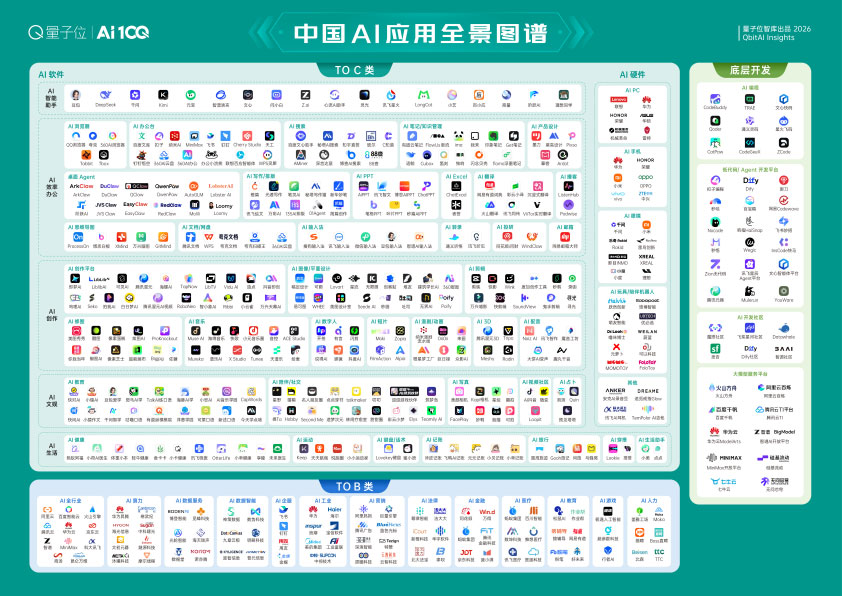
图谱横跨ToC软硬件、ToB应用、底层开发三大维度,覆盖数百款产品,组成一条完整的AI价值传导链。

技术向下渗透,场景向上生长,一个完整的AI产业生态已经成形。

生态有多大,数字最诚实

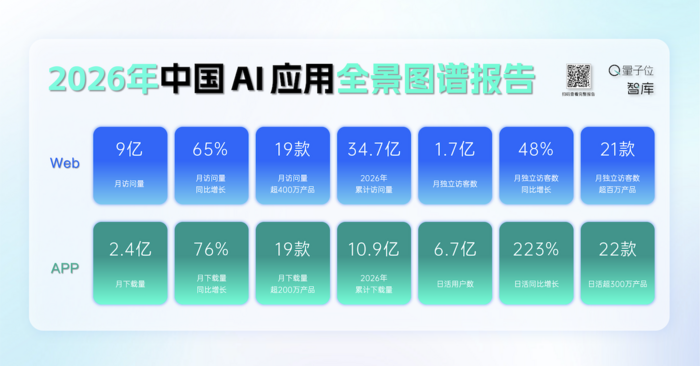
根据量子位智库统计,2026年4月,国内AI应用Web端月访问量突破9亿,APP端月下载量超2.4亿,日活同比暴涨223%。

国家统计局数据显示,2026年中国日均Token调用量突破140万亿,两年增长超千倍。

中国,已是全球AI应用活跃度最高的国家。

但比总量更值得看的,是结构的变化。

量子位智库将国内AI应用分为AI智能助手、AI文娱生活、AI效率办公、AI创作四大赛道。

在关键的用户活跃和用户留存两项指标面前,不同赛道的表现已经拉出明显差异——

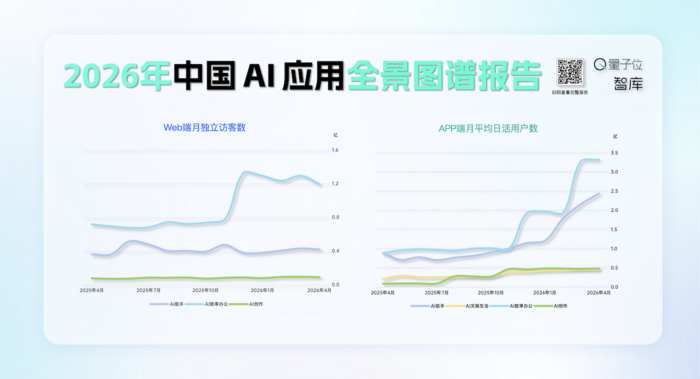
在用户活跃方面,AI效率Web端用户活跃份额超七成,AI创作APP端日活年增449%,表现亮眼。

流量高涨背后,还有一道更残酷的考题在等着:留存。

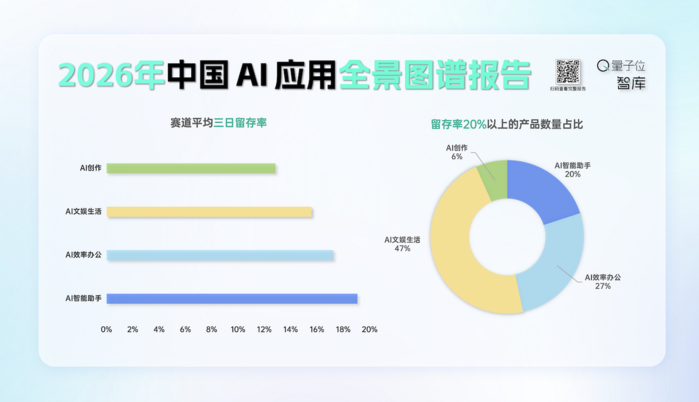
在用户留存方面,智能助手留存最高,AI文娱赛道呈现黏性两极分化。

用户不会因为「好玩」每天回来。但如果AI嵌进了用户的日常工作流,他就几乎不会离开。

这正是2026年最重要的分水岭:从「好玩的AI」到「离不开的AI」。

五大趋势重塑行业

数据截面之外,是五条正在重塑行业的趋势。

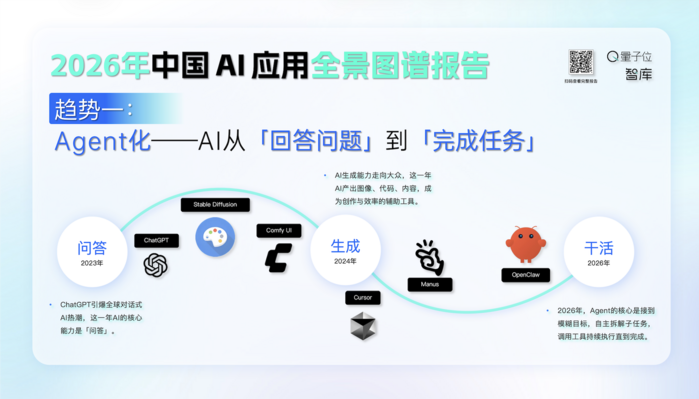
1.Agent化——AI从回答问题进化到完成任务。

据统计,Agent单次Token消耗达传统AI百倍。

2026年的AI应用不再满足只做对话框里的答题机,而是逐渐实现主动规划、调用工具、执行多步骤任务。

竞争重心已从「谁先做出Agent 」转向「谁能在垂直场景做得更深、留住用户」。

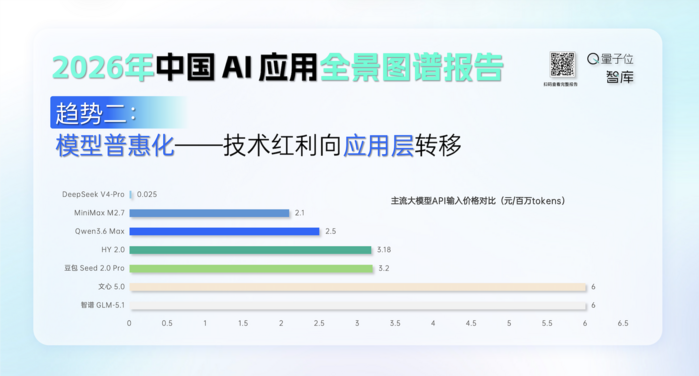
2.模型普惠化——技术红利向应用层转移

Agent能跑起来,离不开另一件事:成本下来了、能力上去了。

DeepSeek V4-Pro API价格仅0.025元/百万tokens,是GPT-5.5的七分之一。

同时,以Seedance2.0为代表的视觉多模态生成模型能力突破,也为生成产品打开新的想象力和产品空间。

成本打穿、天花板提高,意味着更多人可以入场。

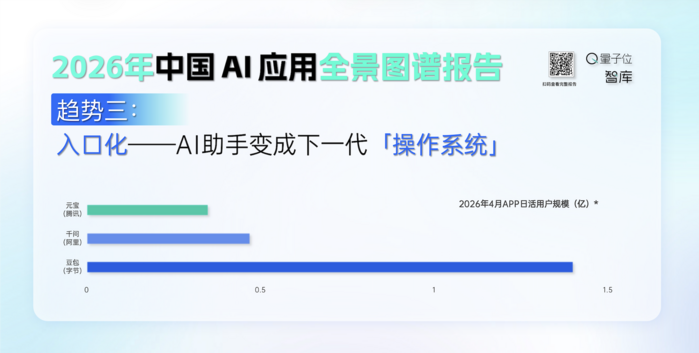
3.入口化——AI助手变成下一代「操作系统」

今年春节,字节、阿里、腾讯、百度四家模型巨头合计砸出超45亿,抢的不是用户,是「需要AI的第一秒打开谁」的本能。

谁赢得用户的默认习惯,谁赢得下一个10年。

烧钱抢入口,不禁让人想问:钱能收回来吗?

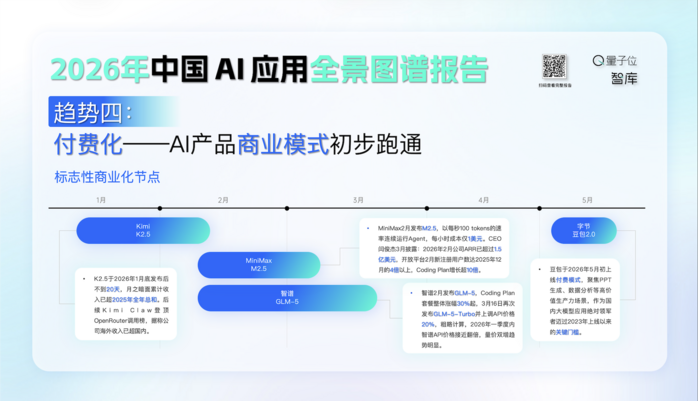
4.付费化——AI产品商业模式初步跑通

Kimi K2.5发布不到20天,收入超2025年全年;智谱API提价后调用量反增;豆包上线付费模式。

这些标志性商业化节点的发生说明——当AI真正嵌进工作流,用户不需要被说服,付费是自然结果。

C端付费逻辑刚刚跑通,而B端的故事则更深、更慢、也更难被撼动。

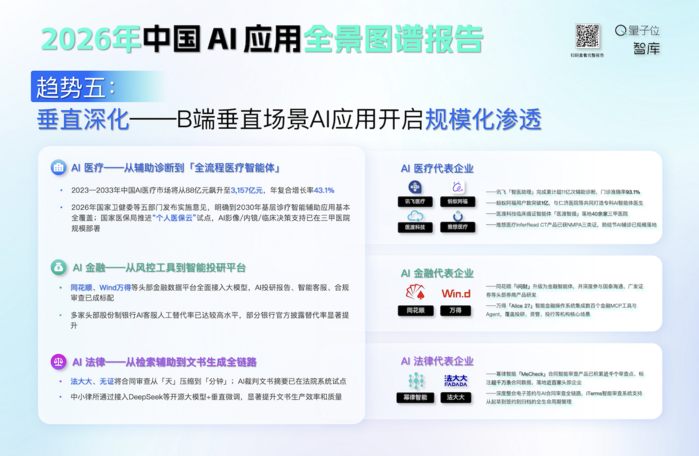
5.垂直深化——B端垂直场景AI应用开启规模化渗透

医疗、金融、法律或许是渗透最快的三个高价值战场。

数据飞轮加私有知识图谱,让老玩家的护城河越筑越深,进场越晚或将越难翻越。

从聊天到「干活」,从尝鲜到「离不开」。

AI应用的这一年,不是终局,是开局。

下一个10年,谁会成为入口、谁能跑通付费、谁又能打穿场景、下一波趋势又会是什么?

答案,交给时间,也交给用户。

注:文/龚作仁,文章来源:Laborer,本文为作者独立观点,不代表亿邦动力立场。

文章来源:Laborer

广告
微信
朋友圈

这么好看,分享一下?

朋友圈 分享

APP内打开

+1
+1
微信好友 朋友圈 新浪微博 QQ空间
关闭
收藏成功
发送
/140 0