广告
加载中

谋求废除中国“最惠国待遇”?美国将调查撤销中国永久正常贸易地位的影响

王昱 2026-02-28 10:49
王昱 2026/02/28 10:49

邦小白快读

EN
全文速览

美国调查撤销中国永久正常贸易关系(PNTR)地位,可能导致进口中国商品关税大幅上升。

1. 调查重点评估撤销PNTR后,对中国商品征收Column 2税率的直接影响,该税率通常为20%至40%,远高于当前最惠国(MFN)2%至3%的平均关税。

2. 撤销后,基础税率会跃升至Column 2水平,并可能叠加其他惩罚性关税(如301条款关税),使综合税率远超现行水平。

3. 报告预计8月21日前提交,公众书面评论截止日期为4月13日,无公开听证会。

4. 此举预示着中美经贸关系可能面临更深层次结构性调整,影响美国相关产业的贸易流量、产出和价格。

操作建议是及时关注政策进展,评估个人或企业面临的风险并调整策略。

关税上升将直接影响品牌定价和产品策略。

1. 品牌定价和价格竞争方面:撤销中国PNTR可能使进口商品税率从2%至3%升至20%至40%,导致成本激增,迫使品牌重新评估定价模型以维持竞争力。

2. 产品研发启示:考虑到纺织品等品类税率可能接近90%,品牌需转向本地化或多元化研发,避开高税率商品类目。

3. 消费趋势观察:用户行为可能因价格上涨而转向国内产品,品牌应监控价格水平变化对消费需求的影响。

4. 品牌渠道建设:结合风险提示,品牌可优化供应链渠道,减少对中国制造依赖,探索低关税市场合作。

政策变化带来潜在风险和应对机会。

1. 政策解读:美国撤销中国PNTR地位调查,可能导致进口关税大幅增加,增加卖家成本压力。

2. 风险提示:综合税率升高(部分商品曾达145%)将直接负面影响销售利润;需警惕库存积压风险。

3. 机会提示:消费需求变化可能推动增长市场转向本地或多元化供应;合作方式上,可寻求平台扶持政策或新贸易伙伴。

4. 事件应对措施:利用4月13日前公众意见提交期发声;可学习点在于监控政策报告(8月21日前提交),及时调整商业模式以规避冲击。

5. 正面影响是推动寻找替代市场,帮助卖家适应新环境。

生产成本上升需调整生产和创新需求。

1. 产品生产和设计需求:撤销PNTR后,美国关税激增(如纺织品税率近90%)可能减少订单,工厂需优化设计以避开高税率品类或转向内销。

2. 商业机会:推进数字化可降低依赖,如电商启示是开发在线直销模式以减少中间环节成本。

3. 风险提示:进口成本增加影响产出,需评估生产调整需求;机会在于探索多元市场以减少美国市场冲击。

4. 整体启示:工厂应关注政策动向(如报告分阶段上调关税情景),及时响应新需求以维持竞争力。

行业发展趋势带来新服务需求和解决方案。

1. 行业发展趋势:关税上升加剧供应链挑战,影响贸易流量和价格水平,服务商可关注政策变化对客户痛点的影响。

2. 客户痛点:进口商面临Column 2税率导致的成本飙升问题,需解决方案降低风险。

3. 解决方案:开发数据分析服务帮助客户预测经济影响(如生产产出变化);提供优化建议如供应链重组或风险管理工具。

4. 新技术启示:结合数字化服务,服务商可推出咨询模块协助企业应对分阶段上调关税情景,提升客户应对能力。

平台运营需应对关税变化带来的挑战。

1. 商业对平台需求和问题:撤销中国PNTR可能导致跨境卖家成本上升,影响平台招商,需调整政策吸引卖家。

2. 平台最新做法:强化风险管理,如监控政策报告(8月21日前提交)以更新运营规则;机会在于推出扶持政策缓解冲击。

3. 平台招商启示:转向本地或多元化卖家以减少依赖高关税商品;结合消费趋势,优化招商策略吸引新兴市场伙伴。

4. 风向规避:建议平台加强运营管理,提供风险提示工具帮助卖家规避政策不确定性。

政策动向揭示产业新问题和启示。

1. 产业新动向:美国调查撤销中国PNTR地位(2000年授予),预示中美经贸结构性调整,引发新经济问题如贸易流量影响。

2. 新问题:高关税(Column 2税率达20%至40%)叠加惩罚措施的经济影响;政策法规启示包括为国会立法提供参考,建议关注公平性和国际合规。

3. 商业模式启示:企业需创新适应税率跃升(如从2%至3%升至20%至40%),探索分阶段上调关税情景下的持续经营模式。

4. 整体趋势:报告将分析生产产出和价格变化,为商业模式研究提供数据支持,帮助理解政策影响深层含义。

返回默认

声明:快读内容全程由AI生成,请注意甄别信息。如您发现问题,请发送邮件至 run@ebrun.com 。

我是 品牌商 卖家 工厂 服务商 平台商 研究者 帮我再读一遍。

Quick Summary

A U.S. investigation into revoking China's Permanent Normal Trade Relations (PNTR) status could lead to significant tariff hikes on Chinese imports.

1. The investigation focuses on the immediate impact of applying Column 2 tariff rates (typically 20–40%) if PNTR is revoked, compared to the current Most-Favored-Nation (MFN) average of 2–3%.

2. Revocation would raise base tariffs to Column 2 levels, potentially compounded by punitive tariffs (e.g., Section 301), pushing overall rates well above current levels.

3. The report is due by August 21, with public written comments accepted until April 13; no public hearings are scheduled.

4. This move signals potential structural shifts in U.S.-China trade relations, affecting trade flows, output, and prices in related U.S. industries.

Monitor policy developments closely and assess risks to adjust strategies accordingly.

Tariff increases will directly impact brand pricing and product strategies.

1. Pricing and competition: Revoking PNTR could raise import tariffs from 2–3% to 20–40%, forcing brands to reassess pricing models to stay competitive.

2. R&D implications: With rates for categories like textiles potentially nearing 90%, brands should pivot to localized or diversified product development to avoid high-tariff items.

3. Consumer trends: Rising prices may shift demand toward domestic products; monitor how price changes affect consumer behavior.

4. Channel strategy: Optimize supply chains to reduce reliance on Chinese manufacturing and explore partnerships in low-tariff markets.

Policy shifts present risks and adaptation opportunities.

1. Policy context: The U.S. investigation into revoking China’s PNTR status may sharply increase import tariffs, raising costs for sellers.

2. Risks: Higher composite tariffs (historically up to 145% for some goods) could squeeze profits and increase inventory risks.

3. Opportunities: Shifting demand may favor local or diversified suppliers; leverage platform support programs or new trade partners.

4. Action steps: Submit public comments by April 13; track the policy report (due August 21) to adjust business models proactively.

5. Silver lining: Encourages diversification into alternative markets for long-term resilience.

Rising production costs necessitate operational adjustments and innovation.

1. Production and design: Tariff spikes (e.g., ~90% for textiles) may reduce U.S. orders; pivot to domestic sales or redesign products to avoid high-tariff categories.

2. Opportunities: Digitalization (e.g., direct-to-consumer e-commerce) can reduce dependency and intermediate costs.

3. Risks and mitigation: Assess production impacts from higher import costs; explore diversified markets to offset U.S. market volatility.

4. Key takeaway: Monitor policy developments (e.g., phased tariff scenarios) and adapt swiftly to maintain competitiveness.

Industry shifts create new service demands and solutions.

1. Trend analysis: Tariff hikes amplify supply chain challenges, affecting trade flows and pricing; align services with client pain points.

2. Client pain points: Importers face soaring costs under Column 2 rates, requiring risk-mitigation solutions.

3. Solutions: Offer data analytics to forecast economic impacts (e.g., output changes) and advisory services for supply chain restructuring or risk management.

4. Innovation angle: Develop digital consulting modules to help clients navigate phased tariff scenarios, enhancing resilience.

Platforms must adapt to tariff-induced operational challenges.

1. Merchant needs: PNTR revocation may raise cross-border seller costs, impacting recruitment; adjust policies to retain attractiveness.

2. Platform actions: Strengthen risk management by tracking policy reports (due August 21) and updating rules; introduce support measures to ease transitions.

3. Recruitment strategy: Shift focus to local or diversified sellers to reduce reliance on high-tariff goods; align with consumer trends to attract new market partners.

4. Risk mitigation: Provide tools and alerts to help sellers navigate policy uncertainty.

Policy moves reveal new industrial dynamics and research implications.

1. Industry shift: The U.S. review of China’s PNTR status (granted in 2000) signals structural trade realignments, raising questions about trade flow impacts.

2. Key issues: Economic effects of high tariffs (Column 2’s 20–40%) layered with punitive measures; regulatory insights for congressional legislation on fairness and compliance.

3. Business model adaptation: Firms must innovate to cope with tariff jumps (e.g., 2–3% to 20–40%) and sustain operations under phased tariff scenarios.

4. Research value: The report’s analysis of output and price changes will provide data to decode deeper policy implications.

Disclaimer: The "Quick Summary" content is entirely generated by AI. Please exercise discretion when interpreting the information. For issues or corrections, please email run@ebrun.com .

I am a Brand Seller Factory Service Provider Marketplace Seller Researcher Read it again.

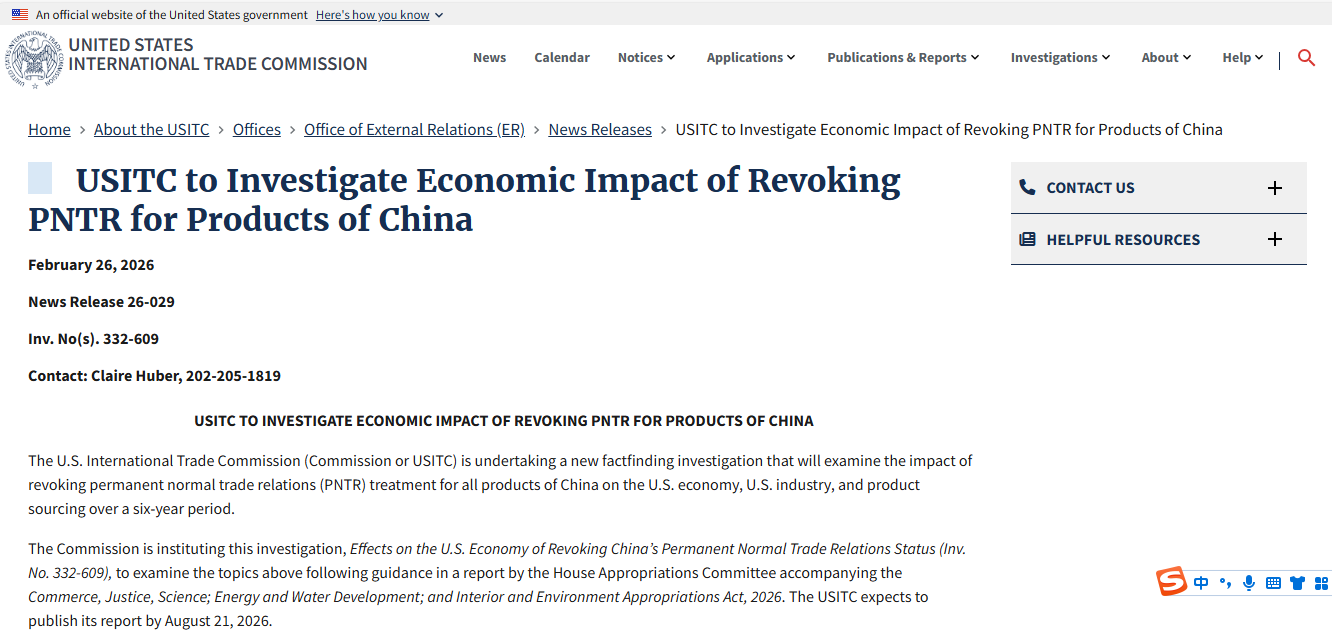
【亿邦原创】2月26日消息,日前,美国国际贸易委员会(USITC)宣布,将启动一项针对撤销中国永久正常贸易关系(PNTR)地位可能带来的经济影响的调查,此举很可能导致对中国进口商品征收更高的关税。该机构明确表示,调查依据国会拨款法案的要求展开,最终报告将于今年8月21日前提交。

自2025年1月特朗普就任总统以来,他已多次指示贸易和商务部门评估取消中国PNTR地位的立法提案。

据悉,这一地位最早于2000年由美国国会授予中国,为中国加入世界贸易组织(WTO)铺平了道路。此后,中国商品在美国享受最惠国关税待遇,基准税率长期保持在较低水平。

然而,特朗普政府自就职首日便启动新一轮对华关税行动,去年部分中国进口商品的综合税率一度攀升至145%。值得注意的是,此前实施的惩罚性关税均是在正常最惠国(MFN)基准税率基础上加征的:在2018年贸易战启动前,美国对中国商品适用的MFN平均关税仅约为2.5%。

一旦中国PNTR地位被撤销,美国将对中国商品适用“非最惠国”税率,即所谓的Column 2税率,这与当前MFN税率存在本质差异。

目前,美国整体MFN平均关税水平仅为2%至3%,而Column 2税率通常高达20%至40%,部分品类甚至更高——例如某些纺织品税率可接近90%。

分析人士指出,两者差距通常超过10倍。若撤销PNTR,中国商品的基础税率将直接从MFN水平跃升至Column 2水平,随后仍可叠加根据其他贸易授权征收的惩罚性关税(如301条款关税),以替代此前被判定违法的紧急关税措施,整体来看,综合税率将远高于现行水平。

美国国际贸易委员会负责该项研究的报告。其声称,将会重点评估在对中国商品征收更高Column 2税率的情况下,美国相关产业的贸易流量、生产产出以及价格水平所受到的“直接且最显著的影响”。

同时,报告还将考察另一种政策情景:即国会撤销PNTR待遇后,对涉及国家安全的重要产品部分关税,在五年内分阶段逐步上调,以缓解短期冲击。

为收集各方意见,美国国际贸易委员会已公开邀请公众就提高对华关税的影响提交书面评论,截止日期为4月13日营业结束。由于时间安排紧迫,委员会表示不会举行公开听证会。

观察人士认为,此次调查不仅是特朗普政府推动对华贸易政策进一步收紧的最新信号,也预示着中美经贸关系可能面临更深层次的结构性调整,其最终结论将为国会后续立法提供重要参考依据。


亿邦持续追踪报道该情报,如想了解更多与本文相关信息,请扫码关注作者微信。

文章来源:亿邦动力

广告
微信
朋友圈

这么好看,分享一下?

朋友圈 分享

APP内打开

+1
+1
微信好友 朋友圈 新浪微博 QQ空间
关闭
收藏成功
发送
/140 0