广告
加载中

阿里云Q2财报:收入同比增长7%至296亿元 公有云AI双驱动

胡镤心 2024-11-15 23:47
胡镤心 2024/11/15 23:47

邦小白快读

EN
全文速览

阿里云2025年第二季度财报展现强劲业务表现。

1.收入达296.1亿元,同比增长7%,环比增长11.5%,连续四个季度增速上升,反映稳健增长态势。

2.经调整EBITA利润同比增长89%至26.61亿元,显示盈利能力显著提升。

3.AI相关产品收入连续五个季度实现三位数同比增长,突显AI驱动核心作用。

4.降价策略如Qwen-Turbo价格直降85%,性价比达到业界最高,为企业提供实操成本优势。

5.客户案例包括小红书构建亚洲最大云上数据湖、海尔智家提升数据处理效率,印证广泛应用价值。

6.全球布局覆盖29个地域85个可用区,支持业务扩展,并持续投入AI基础设施,确保未来增长潜力。

品牌商可关注阿里云在产品研发和消费趋势上的启示。

1.产品研发方面,通义千问模型Qwen2.5发布,性能超越Llama 405B,下载量突破4000万,衍生模型超7.43万,展示技术创新和市场需求。

2.消费趋势显示AI热潮带动企业用云深度提升,影响品牌定位和用户行为,例如三得利中国核心系统迁至阿里云,反映数字化转型普及。

3.品牌营销启示来自降价策略,如Qwen-Plus降价80%后性价比达业界最高,同等规模价格低84%,提供价格竞争和用户吸引新思路。

4.用户行为观察,企业如汉堡王中国关闭线下数据中心全迁云上,突出效率优先趋势,可借鉴于品牌服务优化。

卖家可解读增长市场和机会风险。

1.增长市场方面,AI相关产品收入连续五季度三位数增长,公共云业务双位数增速,提供新销售渠道和需求扩张机会。

2.事件应对措施如阿里云百炼平台模型大幅降价(Qwen-Turbo降价85%),提升可学习点,降低成本应对竞争。

3.机会提示:政企业务服务超1000家客户,包括30+部委和800+央国企,显示合作潜力和招商扶持空间。

4.正面影响包括利润增长89%,因转向高利润公共云产品;负面影响如自由现金流下降70%,主因基础设施投入,需注意资金流风险管理。

5.最新商业模式如“云+AI”协同发展,客户采用PAI平台实现万卡调度,启示弹性服务模式,适用于多样化需求。

工厂可探索产品需求和数字化启示。

1.产品生产需求聚焦于AI基础设施,如磐久AI服务器支持单机16卡、CPFS文件存储数据吞吐达20TB/s,显示硬件组件需求增长。

2.商业机会来自企业用云深度提升,例如海尔智家基于阿里云构建新数据平台,显著提升性能,启示生产环节优化潜力。

3.推进数字化和电商的启示,客户案例如中国石化充电桩“全国一张网”云化管理,或汉堡王中国全业务迁云,展示工厂可借鉴云技术提升运营效率。

4.数字化趋势推动中,阿里云政企服务如飞天企业版智算版,实现通算、超算、智算一网调度,提供智能生产框架参考。

服务商可关注行业趋势和解决方案创新。

1.行业发展趋势显示AI计算、大数据、存储需求激增,企业用云深度提升,带动服务扩容机会。

2.新技术如AI Infra系列,包括HPN7.0高性能网络支持超10万GPU连接、ACS的GPU容器算力提升亲和度,突破技术边界。

3.客户痛点解决案例:MiniMax优化数据预处理和检索,或PAI平台万卡训练推理一体化,算力利用率超90%,提供高效资源管理方案。

4.解决方案突出于阿里云人工智能平台,实现弹性调度;并通过开源生态如通义千问下载量破4000万,强化服务增值点,满足企业效率需求。

平台商可了解平台运营和招商风向。

1.平台最新做法包括降价策略,如Qwen模型Qwen-Turbo降价85%,吸引用户提升市场渗透率,Qwen-Plus性价比业界最高,启示优化定价模型。

2.招商方面,服务超1000家政企客户,包括50+城市大脑和央国企领导者象限,提供合作拓展空间和扶持政策基础。

3.运营管理通过提升效率,利润增长89%部分抵消投入,例如转向高利润公共云产品结构,实现收益优化。

4.风向规避需注意自由现金流下降70%风险,主因基础设施投入;同时,AI Infra产品如磐久服务器发布,展示技术投入平衡点,避免资源浪费。

研究者可分析产业动向和政策启示。

1.产业新动向聚焦AI浪潮,AI相关产品收入高增长,带动云需求深化,如通义千问开源模型衍生超7.43万,反映创新扩散。

2.新问题包括自由现金流下降70%,归因于基础设施投入和退款因素,揭示资金压力挑战。

3.政策法规建议启示自政企合作,如数字重庆“三级数字化中心”建设或中国广电“一云多Region”架构,展示政府云服务模式可行性。

4.商业模式创新如转向利润率更高的公共云产品,EBITA利润提升89%,结合降价策略,提供可持续商业框架,适用于产业优化研究。

返回默认

声明:快读内容全程由AI生成,请注意甄别信息。如您发现问题,请发送邮件至 run@ebrun.com 。

我是 品牌商 卖家 工厂 服务商 平台商 研究者 帮我再读一遍。

Quick Summary

Alibaba Cloud's Q2 2025 financial report demonstrates robust business performance.

1. Revenue reached RMB 29.61 billion, growing 7% year-over-year and 11.5% quarter-over-quarter, marking the fourth consecutive quarter of accelerating growth and reflecting a steady expansion trend.

2. Adjusted EBITA profit surged 89% year-over-year to RMB 2.661 billion, indicating a significant improvement in profitability.

3. AI-related product revenue has achieved triple-digit year-over-year growth for five consecutive quarters, highlighting the core driving role of AI.

4. Price reduction strategies, such as the 85% cut for Qwen-Turbo, have delivered the industry's best cost-performance ratio, providing enterprises with tangible cost advantages.

5. Customer cases, including Xiaohongshu building Asia's largest cloud-based data lake and Haier Smart Home enhancing data processing efficiency, validate broad application value.

6. Global coverage spans 29 regions and 85 availability zones, supporting business expansion, while continued investment in AI infrastructure ensures future growth potential.

Brands can draw insights from Alibaba Cloud's product development and consumer trends.

1. In product development, the release of the Tongyi Qianwen model Qwen2.5, which outperforms Llama 405B with over 40 million downloads and more than 74,300 derivative models, showcases technological innovation and market demand.

2. Consumer trends indicate that the AI boom is deepening enterprise cloud adoption, influencing brand positioning and user behavior, as seen in Suntory China migrating its core systems to Alibaba Cloud, reflecting widespread digital transformation.

3. Marketing insights stem from price cuts, such as the 80% reduction for Qwen-Plus, which offers the industry's best cost-performance ratio and an 84% lower price for equivalent scale, providing new ideas for competitive pricing and customer attraction.

4. User behavior observations, like Burger King China closing its offline data center to fully migrate to the cloud, highlight an efficiency-first trend that can inform brand service optimization.

Sellers can interpret growth markets and opportunity risks.

1. In growth markets, AI-related product revenue has seen triple-digit growth for five consecutive quarters, and public cloud business has achieved double-digit growth, offering new sales channels and demand expansion opportunities.

2. Event responses, such as significant price cuts for models on Alibaba Cloud's Bailian platform (e.g., Qwen-Turbo down 85%), provide learnable strategies to reduce costs and compete effectively.

3. Opportunity alerts: Government and enterprise services serve over 1,000 clients, including more than 30 ministries and 800+ central state-owned enterprises, indicating partnership potential and business support space.

4. Positive impacts include an 89% profit growth due to a shift to high-margin public cloud products; negative impacts like a 70% drop in free cash flow, mainly from infrastructure investments, require attention to cash flow risk management.

5. Latest business models, such as the synergistic development of "Cloud + AI," where clients use the PAI platform for 10,000-card scheduling, inspire flexible service models suitable for diverse needs.

Factories can explore product demand and digitalization insights.

1. Product production demand focuses on AI infrastructure, such as the Panjiu AI server supporting 16 cards per machine and CPFS file storage achieving 20TB/s data throughput, indicating growing demand for hardware components.

2. Business opportunities arise from increased enterprise cloud adoption, e.g., Haier Smart Home building a new data platform on Alibaba Cloud with significant performance gains, revealing optimization potential for production processes.

3. Digitalization and e-commerce insights come from client cases like Sinopec's cloud-based management of a national charging station network or Burger King China's full cloud migration, demonstrating how factories can leverage cloud technology to enhance operational efficiency.

4. In the push for digitalization, Alibaba Cloud's government and enterprise services, such as the Apsara Enterprise Edition for AI computing, enable integrated scheduling of general, high-performance, and AI computing, providing a reference framework for smart production.

Service providers should focus on industry trends and solution innovation.

1. Industry trends show surging demand for AI computing, big data, and storage, with enterprises deepening cloud usage, creating service expansion opportunities.

2. New technologies like the AI Infra series, including HPN7.0 high-performance network supporting over 100,000 GPU connections and ACS's GPU container computing enhancing affinity, push technical boundaries.

3. Client pain point solutions: MiniMax optimizing data preprocessing and retrieval, or the PAI platform's integrated training and inference on 10,000 cards with over 90% compute utilization, offer efficient resource management models.

4. Solutions emphasize Alibaba Cloud's AI platform for elastic scheduling; the open-source ecosystem, with Tongyi Qianwen downloads exceeding 40 million, strengthens value-added services to meet enterprise efficiency needs.

Platform operators can learn about platform operations and partnership trends.

1. Latest platform strategies include price cuts, such as the 85% reduction for Qwen-Turbo, to attract users and increase market penetration, with Qwen-Plus offering the industry's best cost-performance ratio, inspiring optimized pricing models.

2. In partnerships, serving over 1,000 government and enterprise clients, including 50+ city brain projects and leaders in the state-owned enterprise quadrant, provides collaboration expansion space and policy support foundations.

3. Operational management improvements, with 89% profit growth partly offsetting investments, such as shifting to high-margin public cloud products, enable revenue optimization.

4. Risk avoidance notes a 70% free cash flow decline due to infrastructure spending; meanwhile, AI Infra products like the Panjiu server launch demonstrate balanced technology investment to avoid resource waste.

Researchers can analyze industry movements and policy implications.

1. Industry trends focus on the AI wave, with high growth in AI-related product revenue driving deeper cloud demand, as seen in over 74,300 derivatives of the open-source Tongyi Qianwen model, reflecting innovation diffusion.

2. New issues include a 70% free cash flow drop, attributed to infrastructure investments and refund factors, revealing funding pressure challenges.

3. Policy insights from government collaborations, like Digital Chongqing's "three-tier digital center" or China Radio and Television's "one cloud, multi-region" architecture, demonstrate viable public cloud service models.

4. Business model innovations, such as shifting to higher-margin public cloud products with an 89% EBITA profit increase, combined with price reduction strategies, offer a sustainable framework for industry optimization research.

Disclaimer: The "Quick Summary" content is entirely generated by AI. Please exercise discretion when interpreting the information. For issues or corrections, please email run@ebrun.com .

I am a Brand Seller Factory Service Provider Marketplace Seller Researcher Read it again.

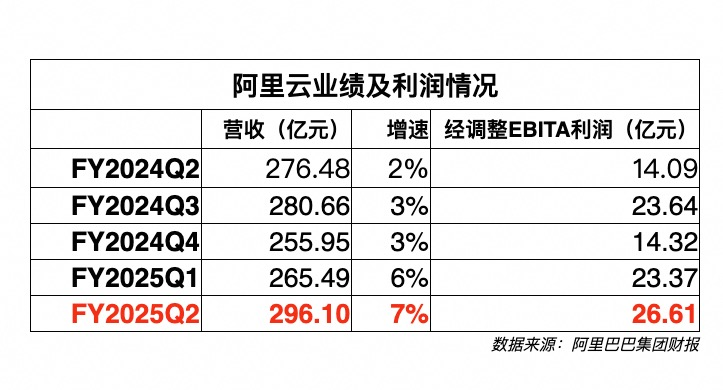
【亿邦原创】11月15日晚间,阿里巴巴集团公布新季度业绩,阿里云季度收入296.1亿元,同比增长7%,对比上一季度265.49亿元,环比增长11.5%。这是阿里云连续第四个季度实现增速上涨。该季度,阿里云经调整EBITA利润达到26.61亿元,同比增长89%。

打了大半年价格战,大力投入AI基础设施建设,大力培养开源生态,阿里云在本轮AI浪潮中的投入巨大。财报显示,阿里巴巴集团自由现金流(一项非公认会计准则财务流动性指标)为人民币137.35亿元(19.57亿美元),相较2023年同期的人民币452.20亿元下降70%。自由现金流的减少主要归因于对阿里云基础设施的投入,取消年度服务费后向天猫商家的退款,以及缩小若干直营业务规模等因素而导致的其他营运资金变动。

同时,阿里云整体收入(不计来自阿里巴巴并表业务收入)同比增长超过7%,由公共云业务的双位数增长带动,AI相关产品采用量提升。其中AI相关产品收入连续五个季度实现三位数同比增长。

季度内,阿里云经调整后EBITA收入同比增长89%,达到26.61亿元。财报表示这一增长主要是由于阿里云将产品结构转向利润率更高的公共云产品(包括AI相关产品),同时持续提升运营效率,但利润增长部分被对客户增长和技术的持续投入所抵消。

过去一年阿里云政企业务已迈入健康轨道。为满足政企客户“云+AI”协同发展需求,阿里云发布了飞天企业版智算版和百炼专属版2.0,实现通算、超算、智算一网调度与管理运维。

阿里云深度参与数字重庆建设,通过全栈云能力,以阿里云重庆政务云为基础,协助打造了数字重庆最大特色、最大亮点的“三级数字化城市运行和治理中心”系统;基于飞天企业版,中国广电采用“一云多Region”和“一云多芯”架构,构建运营商级别的云平台;联合国家天文台及中科院地化所,先后发布了天文大模型“星语3.0”以及全球首个“月球大模型”。截止目前,阿里云已服务超过1000家大型政企客户,包括30+部委及直属单位、50+城市大脑、800+央国企,并获得2024年央国企云上服务能力领导者象限。

同时,AI热潮带动AI计算、大数据、存储、数据库等需求,企业用云深度进一步提升。

本季度,通义千问新一代开源模型Qwen2.5发布。旗舰模型Qwen2.5-72B性能超越Llama 405B。截至9月,通义千问开源模型累计下载量已经突破4000万,海内外开源社区中Qwen的衍生模型数量已突破7.43万。

继5月首次大幅降价后,阿里云百炼平台上的三款通义千问主力模型再次降价。Qwen-Turbo价格直降85%,低至百万tokens 0.3元,Qwen-Plus和Qwen-Max分别再降价80%和50%。其中,Qwen-Plus推理能力追平GPT4,可应用于复杂任务,是效果、速度及成本均衡的最优选择,降价后,Qwen-Plus性价比达到业界最高,同等规模较行业价格低84%。

在9月云栖大会上,阿里云首次对外展示全新升级后的AI Infra系列产品和能力。在基础设施层,阿里云推出最大支持单机16卡的磐久AI服务器、数据吞吐量达20TB/s的CPFS文件存储,以及可支持超过10万个GPU稳定连接的高性能网络架构HPN7.0。在平台层,阿里云ACS首次推出GPU容器算力,通过拓扑感知调度提升了计算亲和度和性能。同时,阿里云人工智能平台PAI实现了万卡级别的训练推理一体化弹性调度,AI算力有效利用率超过90%。

大模型独角兽MiniMax和月之暗面采用阿里云大数据产品,优化模型数据预处理和检索环节;小红书基于阿里云构建亚洲最大的云上数据湖;海尔智家也基于阿里云构建全新数据平台底座,显著提升数据处理性能和效率;汉堡王中国运营公司TFI宣布关闭线下数据中心,全部业务系统迁至阿里云。三得利(中国)核心系统已全面搬迁至阿里云平台。中国石化最近宣布充电桩都跑在阿里云上,实现“全国一张网”。

截止目前,阿里云在全球29个地域设立了85个可用区。未来,阿里云将继续投入于客户增长和技术,尤其是人工智能基础设施方面。

亿邦持续追踪报道该情报,如想了解更多与本文相关信息,请扫码关注作者微信。

文章来源:亿邦动力

广告
微信
朋友圈

这么好看,分享一下?

朋友圈 分享

APP内打开

+1
+1
微信好友 朋友圈 新浪微博 QQ空间
关闭
收藏成功
发送
/140 0